

Step-by-step cross-platform promotion works like this: pick one goal, map your audience to the platforms that match it, build one strong core asset, adapt that asset for each platform's native format, schedule it on a shared calendar, launch with clear roles, and track everything through one unified reporting layer instead of five separate dashboards.
The sequence runs goal, audience, platform roles, core asset, adaptation, schedule, launch, measurement. Skip a step and you get disconnected posts that look busy but don't move the numbers that matter.
Here's the checklist version you can screenshot right now:
- Set one campaign objective and the metric that proves it worked
- Choose 3 to 5 platforms based on where your audience already spends time
- Build one long-form core asset before touching any platform-specific edits
- Adapt that asset natively for each channel instead of copy-pasting it
- Assign a UTM structure and a single owner per platform before launch
- Review performance against a shared dashboard weekly, not per platform
Key Takeaways
Coordinated, platform-native adaptation of one core asset outperforms identical cross-posting, and a unified tracking layer is what makes that coordination measurable.
| Point | Details |
|---|---|
| Coordination beats repetition | Brands active on three or more platforms see up to 73% higher recall than single-platform brands. |
| Adapt, don't copy | Platform-native formats outperform straight reposts by roughly 40%. |
| Build the repurposing matrix first | One long-form asset should generate 3 to 5 platform-native pieces before scheduling begins. |
| Measure at two levels | Track platform metrics and business metrics separately, then reconcile them weekly. |
| Consolidate CTAs with one hub | Lflow's link-in-bio hub unifies every platform's CTA into one trackable link for faster setup and cleaner analytics. |
Table of Contents
- Why Coordinated Cross-Platform Promotion Beats Single-Channel Pushes
- What's the Difference Between Cross-Promotion, Cross-Posting, and Cross-Platform Promotion?
- Which Formats and Partners Work Best for Each Campaign Goal?
- How Do You Execute a Cross-Platform Campaign Step by Step?
- How Do You Measure and Attribute Cross-Platform Performance?
- How Long Should a Cross-Platform Campaign Run and What Does It Cost?
- What Tools and Templates Actually Make This Easier?
- What Does a Real Cross-Platform Campaign Calendar Look Like?
- What's on the Pre-Launch Checklist Before You Publish?
- How Do You Handle Negative Feedback or a Crisis Mid-Campaign?
- What Compliance and Ad Policy Rules Apply Platform by Platform?
- A Practitioner's Take on What Actually Breaks Cross-Platform Campaigns
- Simplify Every Platform's CTA With One Link
- Frequently Asked Questions
- Sources
Why Coordinated Cross-Platform Promotion Beats Single-Channel Pushes
A single well-placed post can perform, but it can't compound. Coordinated promotion works because repetition across channels builds recognition faster than repetition on one feed, and different platforms catch different parts of your audience at different moments in their decision.

Brands that show up consistently across multiple channels generate 2.8 times more engagement than single-platform brands, and companies active on three or more platforms see brand recall climb as much as 73%. That's not a volume game. It's a coverage game: awareness happens on TikTok while consideration happens on YouTube, and neither channel alone can do both jobs.
Think of three quick scenarios. A software company launching a feature update posts a demo clip on Instagram for reach, a longer walkthrough on YouTube for consideration, and an email to existing users for conversion, each channel doing the one job it's actually good at. A local retailer running a giveaway uses Instagram and TikTok to drive entries, then email to capture the list long-term. A B2B consultant building authority uses LinkedIn for credibility and a podcast appearance for depth, then repurposes both into a newsletter. Same core message, three different jobs, one coordinated push.
What's the Difference Between Cross-Promotion, Cross-Posting, and Cross-Platform Promotion?
These three terms get used interchangeably, and that's where campaigns go wrong.
Cross-posting means publishing the identical piece of content on multiple platforms with no adaptation. Cross-promotion means using one channel, partner, or audience to promote another, often through a partnership or shoutout. Cross-platform promotion is the broader system: coordinating original, platform-adapted content and messaging across several channels toward one shared goal.
- Do: turn a long-form video into a 30-second vertical clip for Reels and a text-based thread for X
- Don't: post the same square image with the same caption everywhere and call it a strategy
- Do: ask a podcast host to mention your giveaway and link it in show notes (cross-promotion)
- Don't: assume a partner shoutout on Instagram counts as coverage on LinkedIn too
Cross-promotion is often lower-cost and mutually beneficial, but it fails fast without clear disclosure and planning between partners. The distinction also matters for measurement. If you treat cross-posting as if it were adapted content, your platform-level KPIs will look flat, and you won't know whether the format failed or the platform simply favors something different.
Which Formats and Partners Work Best for Each Campaign Goal?
Not every format belongs on every platform, and not every partner type fits every objective. The mistake most teams make is picking a format they like instead of the one their goal requires.
Platform-native formats consistently beat repurposed content, outperforming straight reposts by roughly 40%. That number alone justifies the extra adaptation time.
| Platform Role | Best-Fit Formats | Ideal Partner Type |
|---|---|---|
| Awareness | Short vertical video, Reels, TikTok clips | Influencers, giveaway partners |
| Consideration | Long-form video, LinkedIn articles, podcast episodes | Co-marketing partners, podcast hosts |
| Conversion | Email, landing pages, retargeting ads | Direct sales partners, affiliate programs |
A few pairings work especially well once you match format to goal:
- Product launches lean on influencer video plus a coordinated email sequence for the audience you already own
- Lead generation campaigns pair a webinar with a LinkedIn promotion cycle and a follow-up email nurture
- Brand recall campaigns rely on repeated short-form video across Instagram and TikTok, reinforced by a podcast mention for credibility
Giveaways deserve a special note: they drive fast follower growth but attract low-intent entrants unless you require a genuine action, like signing up for your email list, not just a follow and a like.
How Do You Execute a Cross-Platform Campaign Step by Step?
This is the operational core. Everything above sets the strategy. This is how you actually build it.
-
Set one campaign objective and one success metric. Not three goals. One. If the goal is "grow awareness and drive sales and build an email list," you have no goal. Pick the single metric that would prove the campaign worked, whether that's new email subscribers, product page visits, or podcast downloads.
-
Map your audience to platform roles and pick 3 to 5 channels. Cross-platform advertising works best when platforms are treated as roles in a system, not interchangeable feeds. Assign one primary job per platform: TikTok and Instagram for awareness, YouTube or LinkedIn for consideration, email for conversion. Resist the urge to run all seven platforms in the mandatory coverage set at once unless you have the team to support it.
-
Produce the core asset first. Before you touch a single platform-specific edit, build the long-form version: a full video, a detailed blog post, or a webinar recording. This becomes your source material for everything else. Define two or three content pillars (the recurring themes your campaign will hit) so every adaptation stays on message.
-
Build the repurposing matrix. A practical pipeline turns one long-form asset into five platform-native pieces: the original long-form video, three to five short vertical clips, a carousel breaking down key points, a text thread for X, and a blog or newsletter summary. Here's a template you can adapt directly:
Core Asset Element Instagram TikTok YouTube LinkedIn Email Hook (first 5 seconds) Reel teaser Short clip Video intro Text hook Subject line Main point Carousel slide Clip 2 Full segment Article excerpt Body paragraph CTA Link in bio Link in bio Description link Featured link Direct link Each platform-native adaptation takes roughly 5 to 10 extra minutes per piece beyond a straight repost, and that time consistently pays for itself in performance.
-
Set your UTM naming convention before you schedule anything. A workable structure looks like this:
utm_source=instagram&utm_medium=social&utm_campaign=springlaunch&utm_content=reel1. Keep the campaign name identical across every platform so your reporting layer can group them, and change onlyutm_sourceandutm_contentper post. -
Assign roles, approvals, and checkpoints. One person owns each platform's publishing. One person owns final creative approval. Build in a checkpoint 48 hours before launch to verify every link, every UTM tag, and every account login. A multi-link strategy for your CTA destinations makes this step far easier when every platform points to one hub instead of five separate URLs.
Pro Tip: Build your repurposing matrix as a living spreadsheet, not a one-time document. Every campaign adds a new row, and within three campaigns you'll have a reusable adaptation playbook instead of starting from scratch each time.
How Do You Measure and Attribute Cross-Platform Performance?
Measurement is where most cross-platform campaigns quietly fall apart. Each platform reports its own numbers in its own format, and none of them talk to each other by default.
Split your measurement into two levels. Level 1 is platform metrics: reach, watch time, saves, click-through rate, the numbers native to each dashboard. Level 2 is business metrics: email signups, purchases, demo bookings, the outcomes that actually matter to your bottom line. Cross-platform advertising spans search, social, streaming, retail media, and programmatic channels, and reconciling them requires an independent measurement layer rather than trusting any single platform's self-reported attribution.
| Platform | Primary KPI | Tracking Method |
|---|---|---|
| Reach, saves | UTM link in bio | |
| TikTok | Views, shares | UTM link in bio |
| YouTube | Watch time | Description link UTM |
| Click-through rate | Featured link UTM | |
| X (Twitter) | Engagement rate | UTM shortlink |
| Open rate, click rate | Native email platform tracking | |
| Podcast | Downloads | Vanity URL or promo code |
Set your reporting cadence deliberately:
- Daily: check for broken links and obvious tracking failures during the first 72 hours
- Weekly: review platform-level KPIs against the unified dashboard
- Monthly: compare business outcomes against campaign spend
- Quarterly: assess which platforms are earning their place in the mix
Tracking engagement properly means connecting the platform numbers to the business numbers, not reporting them side by side and hoping the pattern is obvious.
How Long Should a Cross-Platform Campaign Run and What Does It Cost?
Timeline depends on whether you're launching something or sustaining evergreen visibility, and the two need different rhythms.
A short campaign (one to two weeks) fits a giveaway or a single product drop:
- Days 1 to 2: finalize core asset and repurposing matrix
- Days 3 to 4: schedule all platform posts and confirm UTMs
- Days 5 to 10: launch and monitor daily
- Days 11 to 14: wrap-up push and results review
A 30-day campaign suits a product launch with a build-up phase, launch week, and follow-through. A 90-day campaign fits a sustained brand-building push, typically running on a four-week planning cadence with 20% buffer days reserved for reactive or trending content.
Budget in four buckets:
- Creative production (core asset plus adaptations): the largest share for most small businesses
- Paid amplification: boosting the highest-performing organic posts
- Influencer or partner fees: scales with campaign ambition
- Tools and contingency: scheduling software plus a buffer for unplanned opportunities
Launches front-load creative spend early; evergreen promotion spreads a smaller budget more evenly across the full period.
What Tools and Templates Actually Make This Easier?
You don't need a dozen tools. You need the right three or four doing distinct jobs.
For scheduling and repurposing, native platform schedulers work fine for single-channel posting, while multi-platform tools save time once you're managing five or more channels at once. For analytics, an independent measurement layer beats stitching together five platform dashboards by hand, since platform reports use different attribution logic and won't reconcile themselves.
Your content calendar template needs five fields at minimum:
-
Platform and post date
-
Content pillar and format
-
Owner and approval status
-
UTM tag
-
Platform-specific goal for that entry
-
A link-in-bio hub simplifies every CTA across every platform into one trackable destination
-
It removes the need to update five different "link in bio" fields every time a campaign changes
Pro Tip: If your team is optimizing social profiles before a launch, update your link hub first. Every other platform edit becomes faster once one destination is set.
What Does a Real Cross-Platform Campaign Calendar Look Like?
Picture a small skincare brand launching a new serum. Objective: drive 500 email signups in two weeks. Core asset: a 90-second ingredient explainer video. Platforms: Instagram, TikTok, YouTube Shorts, and email.
- Week 1, Days 1 to 3: post the teaser clip on TikTok and Instagram Reels, driving to a link-in-bio hub
- Week 1, Days 4 to 5: publish the full explainer on YouTube Shorts, CTA in description
- Week 1, Days 6 to 7: send launch email to existing list with the same offer
- Week 2, Days 8 to 10: repost top-performing clip with a fresh caption angle
- Week 2, Days 11 to 14: send a reminder email and post a founder-voice follow-up story
Sample UTM: utm_source=tiktok&utm_medium=social&utm_campaign=serumlaunch&utm_content=teaser. Watch the first 72 hours closely. Early click-through rate on the hub link tells you whether the hook is working before you've spent the full budget.
Pro Tip: If day-two engagement drops sharply from day one, the hook is the problem, not the platform. Fix the opening line before you touch the media budget.
What's on the Pre-Launch Checklist Before You Publish?
Run this before anything goes live, not after something breaks.
- Every link opens correctly inside each platform's in-app browser, not just in a regular browser
- Every UTM tag matches the naming convention across all platforms
- Every CTA points to the same destination or hub, with no stray old links
- Every account is confirmed as the correct brand account, not a personal or test profile
- Approvals are signed off by the designated owner, not assumed complete
Watch for red flags: broken links, inconsistent CTAs between platforms, tracking parameters that don't match the campaign name, or a post scheduled to the wrong account entirely. Common operational failures include copying identical creative everywhere and ignoring platform-specific policies, both of which a five-minute QA pass catches easily.
Have a moderation plan ready before launch: who monitors comments, who has posting access to pull content fast, and what the response window looks like if something needs fixing at 9 p.m. on a Saturday.
How Do You Handle Negative Feedback or a Crisis Mid-Campaign?
Every coordinated campaign eventually hits friction. A giveaway attracts spam entries. A comment thread turns critical. A partner posts something off-brand. How you respond in the first hour often matters more than the mistake itself.
Assign one person as the single point of decision during launch week. Nothing kills response time faster than three people debating a reply while the comment thread grows. Pause the paid amplification on the affected post immediately rather than letting the budget keep pushing more eyes toward a problem.
Respond publicly and briefly on the platform where the issue started, then take detailed conversations to email or direct message. Never delete a legitimate complaint just because it's uncomfortable. Deleting valid criticism tends to escalate the platform's attention exactly when you don't want more of it.
If the issue stems from a partner's post rather than your own, have the correction come from your own account first, then coordinate with the partner rather than waiting on them to fix it. Document what happened and what changed, because the same failure mode (a broken link, an unclear disclosure, a mistimed post) tends to repeat across campaigns if nobody writes it down.
Build a short crisis checklist into your pre-launch plan: who has posting access, who monitors comments hourly during launch week, and what the escalation path looks like if a single post needs to come down entirely.
What Compliance and Ad Policy Rules Apply Platform by Platform?
Each platform enforces its own advertising and disclosure rules, and what's fine on one can get a post removed or a campaign flagged on another.
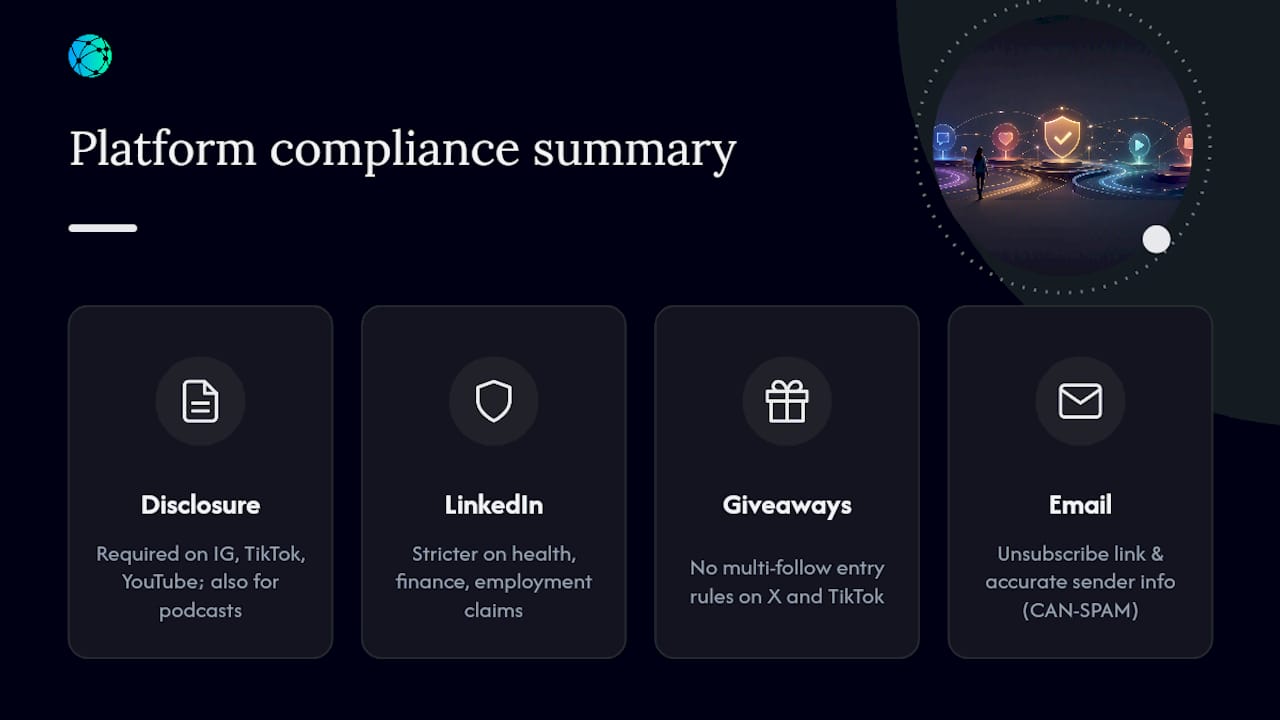
Instagram and TikTok both require clear paid-partnership disclosure tags whenever an influencer or partner is compensated, not just a caption mention buried in hashtags. YouTube requires the same disclosure for sponsored content and enforces it through its own paid promotion toggle. LinkedIn's ad policies are stricter around health, financial, and employment claims than most other platforms, which matters if your campaign touches any of those categories.
X (Twitter) and TikTok both restrict certain giveaway mechanics, particularly ones that require following multiple accounts as a condition of entry, so check current giveaway rules on each platform before launch rather than assuming last year's rules still apply. Email carries its own legal requirement: every promotional email needs a working unsubscribe link and accurate sender information under CAN-SPAM.
Podcasts have looser platform-level enforcement but still require disclosure when an episode includes paid promotion, particularly if it airs on platforms that syndicate to Apple Podcasts or Spotify, both of which have their own content guidelines. The safest approach across every channel: disclose partnerships clearly, avoid claims you can't back up, and re-check each platform's current ad policy before a launch, since these rules shift more often than most campaign calendars account for.
A Practitioner's Take on What Actually Breaks Cross-Platform Campaigns
Most cross-platform failures don't come from picking the wrong platforms. They come from treating adaptation as optional once the core asset is done, and from spreading a small team across too many channels instead of doing three well. The teams that get this right treat the repurposing matrix as the actual campaign, not an afterthought tacked onto a single hero post. Lflow's link-in-bio approach works well as the connective layer that keeps every platform's CTA pointed at one trackable destination instead of five drifting ones. If you want to see the workflow in practice, the sample calendar above is a reasonable starting template to copy.
Simplify Every Platform's CTA With One Link
Running five platforms means five different "link in bio" fields to update every time a campaign changes, unless you consolidate them into one destination. A link-in-bio hub solves the exact problem this guide keeps circling back to: one URL that updates everywhere at once, with click data broken down by source so you can see which platform is actually driving signups instead of guessing.
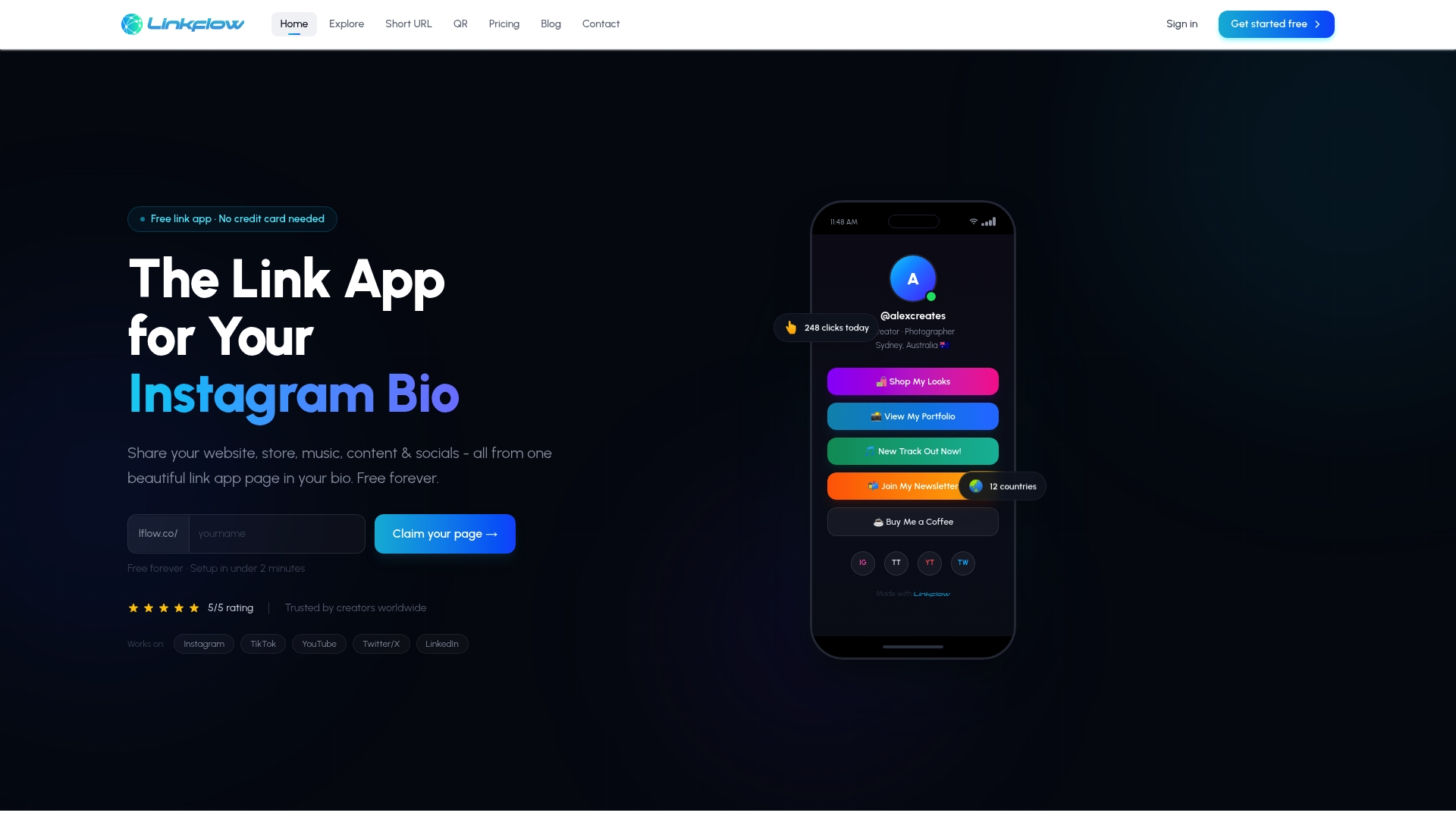
Two things make this practical for the campaign structure above: publishing goes faster because you edit one hub instead of five bio fields, and your click analytics come pre-unified by link and by source rather than scattered across platform dashboards. Add a free QR code to the same hub for offline promotion, like a flyer, a product package, or an event booth, so foot traffic feeds into the identical tracking layer as your social clicks. Set up a free hub, drop your campaign links in, and point every platform's bio at it before your next launch.
Frequently Asked Questions
What is cross-platform promotion? Cross-platform promotion is coordinating original, platform-adapted content and messaging across multiple channels toward one shared campaign goal, rather than posting the same content everywhere or relying on a single channel.
How is cross-platform promotion different from cross-posting? Cross-posting means publishing identical content across platforms with no adaptation. Cross-platform promotion adapts the same core message natively for each channel's format and audience behavior.
How many platforms should a small business use for one campaign? Most campaigns work best with 3 to 5 platforms, each assigned a distinct role like awareness, consideration, or conversion, rather than spreading thin across every channel available.
What's the fastest way to start a step-by-step cross-platform promotional strategy? Set one objective, build one long-form core asset, adapt it into platform-native pieces, and route every CTA through a single trackable link before you schedule the first post.
Do I need paid ads for effective cross-channel promotion? No. Organic coordination across platforms, backed by a unified calendar and consistent CTAs, can drive strong results, though paid amplification can accelerate reach once you know which organic post is performing.
Sources
- Cross-Platform Social Media Strategy: The 2026 Guide - Brandlix Blog
- Cross-Platform Advertising: Strategy, Challenges & Measurement
- Cross-Platform Social Media Strategy 2026: One Post, Five Networks | ToolifyApps
- Cross-Platform Promotion - Moimobi