

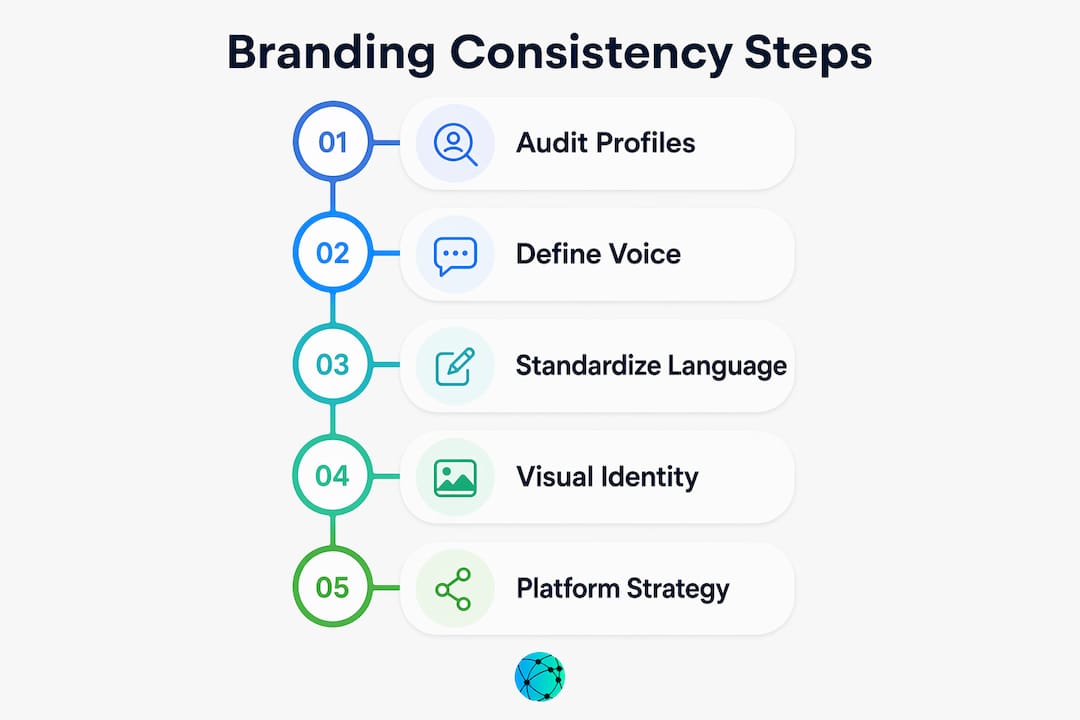
A social media branding guide is a strategic document that defines exactly how your brand looks, sounds, and behaves across every platform. Done right, it removes guesswork for your entire team and makes every post, reply, and story feel like it came from the same source. The ten core elements every guide should cover are:
- Social media profiles (photo, bio, URL, pinned content)
- Brand voice and tone (personality, adjectives, platform shifts)
- Language and grammar rules (spelling, punctuation, approved terminology)
- Visual formatting (color palette, typography, templates)
- Hashtag conventions (branded, community, trending)
- Platform-specific strategies (TikTok vs. LinkedIn vs. Instagram)
- Content pillars (3–5 recurring themes aligned to brand values)
- AI usage guardrails (what tools are approved and how to use them)
- Accessibility standards (alt text, contrast ratios, inclusive language)
- Dos and don'ts (clear examples of on-brand vs. off-brand behavior)
Many brands have inconsistent branding across their social platforms. That inconsistency confuses customers and erodes the recognition you've worked to build. A well-structured guide fixes that before it becomes a problem.
How do you brand your social media profiles effectively?
Your profile is the first thing a new visitor judges. They spend a very short time deciding whether to follow, and every element either earns trust or loses it.
Profile optimization is one of the highest-impact, lowest-cost steps in any social media branding checklist. A clear photo or logo, a bio that states who you help and how, and a consistent handle across platforms all contribute to faster follower conversion. Inconsistent naming across channels forces people to wonder if they've found the right account.
Key profile elements to standardize:
- Profile photo: Use the same image across all platforms. For personal brands, a clean headshot with good lighting. For businesses, your logo on a neutral background at the platform's recommended resolution (most use 400×400px; LinkedIn company pages use 300×300px).
- Bio copy: State your purpose, your audience, and what they gain by following. Avoid vague labels. "I help DTC brands grow on Instagram" beats "Content creator | Marketing enthusiast."
- Handle consistency: Match your username as closely as possible across Instagram, TikTok, LinkedIn, X, and YouTube.
- Link in bio: Use a single branded URL that consolidates your key destinations. This is where a tool like Lflow pays off directly, giving you one professional hub for your website, store, and social profiles.
- Pinned content: Treat pinned posts and story highlights as permanent branding real estate. Update them quarterly or whenever you have a stronger performer.
Pro Tip: Run a profile audit every 90 days. Open each platform in a fresh browser window as a first-time visitor and ask: "Do I immediately understand what this brand does?" If the answer is no, the bio or photo needs work.
How do you establish a consistent brand voice across platforms?
Brand voice is the personality behind every word you publish. It's what makes your captions, replies, and stories feel like they came from the same person, even when a team of five is writing them.
Start by choosing three to five adjectives that describe how your brand communicates. "Direct, warm, and a little irreverent" is a voice. "Professional and friendly" is too vague to be useful. Once you have those adjectives, write examples of on-brand and off-brand sentences for each one so your team can see the difference in practice.
Tone is how voice shifts by context. Your core personality stays fixed, but a LinkedIn post about an industry trend reads differently than a TikTok caption for a behind-the-scenes video. The underlying brand is the same; the register adapts. A brand voice matrix documents exactly which elements stay constant and which flex per platform, and it's the most practical tool for fighting brand drift when you're managing multiple accounts.
Steps to define your voice:
- Write your three to five voice adjectives with a one-sentence definition for each.
- Create a "sounds like / doesn't sound like" chart with real examples.
- Map tone shifts by platform (formal on LinkedIn, conversational on Instagram, authentic and unpolished on TikTok).
- Share the matrix with every person who publishes on your behalf.
What language, grammar, and hashtag rules should your guide include?
Language standards prevent the small inconsistencies that quietly undermine credibility. Does your brand use Oxford commas? Do you write "%" or "percent"? Do you capitalize product names? These decisions feel minor until a customer notices your Instagram bio spells a product differently than your LinkedIn headline.
Your guide should lock in spelling preferences, punctuation rules, approved terminology, and any words or phrases that are off-limits. Include a short glossary of brand-specific terms so contractors and new hires use them correctly from day one.
Hashtag strategy deserves its own section because it touches discoverability, campaign tracking, and brand identity simultaneously. Mid-size, audience-relevant hashtags outperform chasing the largest tags on platforms like Instagram and TikTok. A tag with 50,000 posts gives your content a realistic chance of being seen by the right people; a tag with 50 million buries it instantly.
Hashtag conventions to document:
- Branded hashtags: Your unique tag (e.g., #YourBrandName) for UGC collection and campaign tracking.
- Community hashtags: Niche-specific tags your audience already follows.
- Trending tags: Use selectively and only when genuinely relevant to the content.
- Platform rules: Instagram supports up to 30 tags but 5–10 targeted ones typically perform better. TikTok favors 3–5 relevant tags. LinkedIn hashtags work best in groups of 3.
- Accessibility: Capitalize each word in multi-word hashtags (#SocialMediaTips, not #socialmediatips) so screen readers can parse them correctly.
How should your visual identity look across social platforms?
Visual consistency is what makes your content recognizable at scroll speed; documenting your color palette and typography is essential for crafting and maintaining strong brand identity on social channels. A viewer shouldn't need to see your logo to know a post is yours. Three to five colors, two fonts, and a defined imagery style are enough to build that recognition.

Document your color palette with hex codes for digital use and RGB values for screen rendering. Assign each color a role: primary for backgrounds, accent for calls to action, neutral for text. Typography works the same way. Pick a headline font and a body font, then stick to them. Mixing three or four typefaces across your posts is one of the fastest ways to look unpolished.
Templates are the practical engine of consistency. Build five to ten core layouts for your most common content types: quote graphics, product showcases, educational carousels, and announcements. When every post doesn't require design decisions from scratch, your team moves faster and your feed looks more cohesive. Tools like Canva let you set up a brand kit with locked colors, fonts, and logos so templates stay on-brand even when someone else uses them.
Platform-specific constraints matter too. Instagram feed posts work at 1:1 or 4:5. Stories and Reels use 9:16. LinkedIn favors 1.91:1 for link previews. YouTube thumbnails are 1280×720. Building these specs into your templates prevents awkward cropping and last-minute resizing.
Pro Tip: Set a "brand drift" review into your content calendar every month. Pull your last 20 posts from each platform side by side. If the color palette or typography has wandered, trace it back to which template was modified and fix the source file.
How do platform-specific strategies and content pillars work together?
Not every platform deserves equal attention, and trying to be everywhere at once usually means being mediocre everywhere. Audience segmentation drives better results when you pick two or three platforms where your audience actually spends time and go deep on those, rather than spreading thin across eight channels.
TikTok skews younger and rewards authenticity over polish. LinkedIn is where B2B credibility gets built through thought leadership. Instagram sits in the middle, favoring strong visuals and community engagement. The platform culture shapes how your brand voice adapts, which is why your guide needs platform-specific sections rather than one-size-fits-all rules. For a deeper look at managing identity across multiple channels, Lflow's breakdown of consistent brand identity across platforms covers the tradeoffs clearly.
Content pillars give your posting calendar structure. Define three to five recurring themes that align with your brand values and genuinely serve your audience. A marketing software brand might use: industry news, how-to tutorials, behind-the-scenes culture, customer success stories, and product education. Every piece of content maps to one pillar. This prevents the "what do we post today?" scramble and keeps your feed from feeling random.
Platform strategy checklist:
- Select two to three primary platforms based on where your audience is.
- Define content pillars (3–5 themes) with a brief description and example for each.
- Set a realistic posting cadence you can maintain for months, not just weeks.
- Build a content calendar that maps pillars to platforms and dates.
- Review platform analytics monthly and adjust the content mix based on what's actually working.
What does research say about social media branding consistency?
The data on consistency is unambiguous. Brand inconsistency affects 68% of brands and directly weakens customer recognition. The fix isn't complicated, but it requires discipline over time.
Building a social media presence is a long game. Consistent engagement over months compounds into growth that sporadic viral posts never sustain.
The most effective brands focus on connection consistency rather than raw posting volume. Meaningful interactions, thoughtful replies, and content that genuinely serves the audience build more durable trust than hitting a daily post quota. A concise style guide, typically two to three pages with visuals, outperforms a dense 50-page document because teams actually use it.
Practical consistency habits that hold up:
- Keep your style guide to two to three pages with visual examples, not walls of text.
- Use a brand voice matrix to document what stays constant and what adapts per platform.
- Conduct a quarterly audit of all profiles against your guide.
- Schedule content in batches to maintain cadence during busy periods.
- Treat your style guide as a living document and update it when platforms change or your brand evolves.
How do you measure social media branding effectiveness?
Measuring brand consistency goes beyond follower counts. The metrics that matter most are the ones that reflect recognition and trust: profile visit-to-follow rate, branded hashtag usage volume, direct message sentiment, and share-of-voice in your niche.
Most platforms provide native analytics covering impressions, reach, engagement rate, saves, and link clicks. Track these weekly, but look for trends over 30-day and 90-day windows rather than reacting to individual post performance. A single underperforming post tells you almost nothing. A three-month decline in saves on educational content tells you the format or topic mix needs adjusting.
For brand-specific measurement, run a quarterly visual audit: pull your last 30 posts from each platform and check them against your style guide. Are the colors consistent? Is the voice recognizable? Are the templates holding up? This manual check catches drift that analytics dashboards miss. Pair it with social listening tools to monitor how your audience describes your brand in comments and mentions, and whether that language matches the adjectives in your voice guide.
How should you handle a brand crisis on social media?
A brand crisis on social media moves fast. The window between a damaging post going live and it reaching thousands of people can be minutes, not hours. Having a response protocol documented before anything goes wrong is the difference between a controlled response and a reactive one that makes things worse.
Your crisis protocol should define three things: who has authority to respond, what the approved response templates look like for common scenarios, and when to escalate beyond social media to PR or legal. Silence reads as indifference. A holding statement like "We're aware of this and looking into it" buys time without committing to details you don't yet have.
Tone during a crisis shifts, but brand voice doesn't disappear. A brand that's normally warm and direct should still be warm and direct when apologizing, not suddenly stiff and corporate. Audiences notice the register change and it feels inauthentic. After the immediate response, document what happened, how it was handled, and what the guide needs to say differently to prevent a repeat.
How do you build community and drive real engagement?
Community doesn't grow from broadcasting. It grows from conversation. Responding to comments, asking genuine questions in captions, and acknowledging your audience by name in replies all signal that a real person is behind the account.
The highest-return engagement habit for growing accounts is outbound interaction: leaving thoughtful, specific comments on relevant content in your niche. A comment that adds a perspective or asks a useful question puts your brand in front of an already-interested audience. Generic "Great post!" comments do nothing. A comment that says "We tested this exact approach last quarter and found the opposite on LinkedIn, curious if your audience skewed B2C?" starts a conversation.
User-generated content is one of the most efficient community-building tools available. When your audience creates content featuring your brand, resharing it (with credit) rewards the creator, signals to others that the community is active, and provides authentic social proof. Your branded hashtag is the collection mechanism. Document in your guide how to respond when someone uses it, whether you like, comment, repost, or all three. For brands managing multiple link destinations and wanting to give community members a clean, branded hub, Lflow's link in bio pages consolidate everything into one professional destination that matches your visual identity.
Key Takeaways
Consistent social media branding requires a documented guide covering profiles, voice, visuals, hashtags, and platform tactics applied without exception across every channel.
| Point | Details |
|---|---|
| Inconsistency is widespread | 68% of brands have inconsistent branding across platforms, which confuses customers and dilutes recognition. |
| Profiles set the first impression | Standardize your photo, bio, handle, and link in bio across every platform before anything else. |
| Voice matrix prevents drift | Document which brand voice elements stay fixed and which adapt per platform to keep identity coherent at scale. |
| Mid-size hashtags outperform large ones | Audience-relevant hashtags with moderate volume give content a realistic chance of discovery on Instagram and TikTok. |
| Consistency compounds over time | Building social media presence is measured in months, not days; steady engagement outperforms sporadic viral attempts. |