

Social profile optimization is the practice of refining your bio, visuals, links, and metadata so platforms and real people can find, trust, and act on your profile. According to Hootsuite, small but specific tweaks to profile components directly improve follower growth, engagement, and clicks. Whether you run a personal brand on Instagram or a local business on Google, the same core principle applies: your profile is a landing page, and every element either earns attention or loses it. These social profile optimization tips give you a structured, platform-tested path to fix what's costing you visibility right now.
1. Start with the social profile optimization tips that matter most: your bio
Your bio is the first thing an algorithm indexes and the first thing a visitor reads. Hootsuite and SocialPilot both confirm that keyword-rich bios improve discoverability in platform search and external search engines alike. That means your bio needs to work on two levels simultaneously: speak to the algorithm and speak to the human.
InfluencerDB recommends a timed, 60-minute checklist approach to bio overhaul. The workflow prioritizes five elements in order: your photo, your name field, your bio text, your pinned content, and your link. This structure forces you to treat each element as a distinct decision rather than a single block of text.
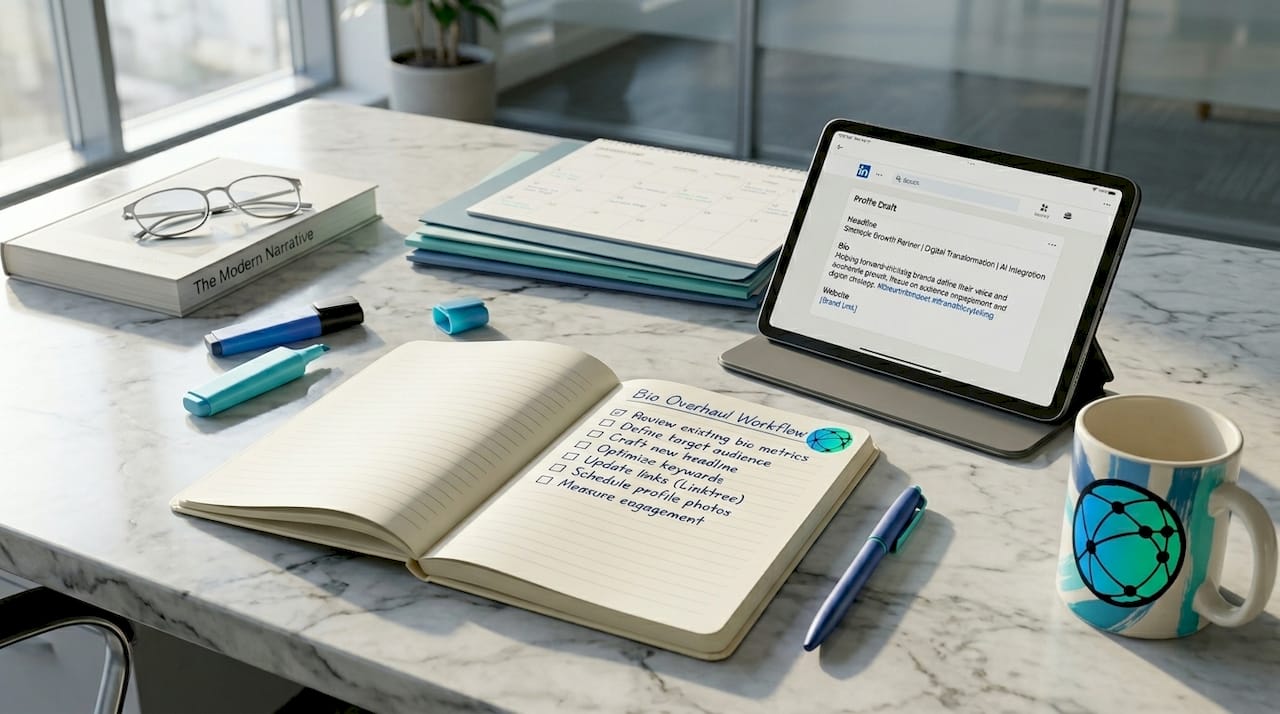
A converting bio follows a four-part structure. State who you are, show proof of credibility, make a clear promise to your audience, and end with one call to action. "Certified nutritionist. 10 years helping busy parents eat better. Free meal plan below." That is 11 words and it does all four jobs.
Pro Tip: Use the name or username field on Instagram and LinkedIn to include a keyword, not just your name. "Sarah Chen | Career Coach" ranks in platform search; "Sarah Chen" does not.
2. Add UTM parameters to every bio link
Most profiles send traffic to a homepage and never know what happened next. Adding UTM parameters to your bio links fixes that by attributing every click to its exact source, whether that is your Instagram bio, your LinkedIn summary, or your TikTok profile.
A UTM link looks like this: "yoursite.com?utm_source=instagram&utm_medium=bio&utm_campaign=spring2026`. Google Analytics 4 reads these parameters and shows you exactly which platform drove signups, purchases, or page views. Without this, you are optimizing blind.
The practical payoff is significant. When you know that your LinkedIn bio drives three times more conversions than your Instagram bio, you know where to invest your next round of profile updates. Trackable links turn profile optimization from guesswork into a measurable project.
3. Choose profile visuals that build trust on first glance
High-quality, consistent profile photos are not a vanity choice. Witty Playbook and professional photography experts confirm that profile images must meet platform-specific specs, maintain consistency across platforms, and include accessibility alt text where supported. Trust decay is real: a blurry or outdated photo signals neglect before a visitor reads a single word.
For individuals, a professional headshot with a clean background and direct eye contact outperforms casual selfies on every platform. For businesses, a high-resolution logo centered within the frame works across LinkedIn, Facebook, and Google. The LinkedIn headshot checklist from professional photographers recommends a focal length equivalent to 85mm or longer to avoid distortion, neutral or on-brand backgrounds, and consistent lighting.
Key visual requirements across major platforms:
- Profile photo size: 400x400 pixels minimum for LinkedIn; 320x320 for Instagram; 400x400 for X (Twitter)
- Header or banner image: 1584x396 pixels for LinkedIn; 1500x500 for X
- Alt text: Add descriptive alt text on LinkedIn and X to improve accessibility and SEO indexing
- Refresh cadence: Update profile photos at least once per year or after a significant rebrand
Pro Tip: Shoot your profile photo and header image in the same session with the same color palette. Visual consistency across platforms builds brand recognition faster than any single great photo.
4. Optimize your Google Business Profile for local discoverability
Google Business Profile (GBP) is a social profile in its own right, and most small businesses treat it as a one-time setup. Shopify and TrueFuture Media are direct: completeness is foundational to GBP eligibility and ranking. Branding alone cannot compensate for missing data.
Every field in your GBP matters. Business name, address, phone number (NAP), website, hours, services, and photos all feed the algorithm. Accurate business categories and service descriptions written in natural language help Google match your profile to the exact queries your customers use.
| GBP Element | Optimization Action |
|---|---|
| Business categories | Choose one primary and up to nine secondary categories that reflect actual services |
| Photos and videos | Upload at least 10 photos; add new images weekly for freshness signals |
| Posts | Publish at least one post per week covering offers, events, or updates |
| Reviews | Respond to every review within 48 hours, positive and negative |
| Q&A section | Pre-populate with five to ten common customer questions and answers |
Photos and weekly posts are confirmed ranking signals by Tall Boy Marketing and TrueFuture Media. Profiles that post regularly appear more often in local search results and AI-generated answer boxes. Treat your GBP like a live feed, not a static directory listing.
5. Use pinned posts and highlights as conversion infrastructure
Pinned posts on X, LinkedIn, and Facebook, and Story Highlights on Instagram, function as mini landing pages for profile visitors. InfluencerDB recommends pinning an intro post, a performance proof post, and a brand-friendly example to guide new visitors through a deliberate sequence. Witty Playbook frames these as conversion infrastructure, not decoration.
The logic is straightforward. A new visitor lands on your profile with no context. A pinned post that says "Here's what I do and who I help, with proof" reduces drop-off immediately. On Instagram, Highlights organized by topic (Services, Testimonials, FAQ) let visitors self-select the information most relevant to them.
For maximizing bio link engagement, pair your pinned content with a multi-link bio page so visitors who click through find a structured menu rather than a single destination. This combination of pinned proof and a well-organized link hub is the most underused tactic in social profile improvement.
6. Apply keyword strategy to every text field, not just your bio
SocialPilot explains that profile metadata is indexed by both platforms and search engines. That means your name field, headline, about section, service descriptions, and even photo captions all contribute to how you rank in search. Most people optimize only their bio and ignore the rest.
On LinkedIn, the headline field (220 characters) carries significant SEO weight. Use it to include your role, your specialty, and the outcome you deliver. "Marketing Consultant | Helping E-Commerce Brands Grow Revenue Through Paid Social" outperforms "Marketing Consultant" in both search ranking and click-through rate.
On Instagram, the username and name fields are the only two text elements the platform indexes for search. Your bio text does not appear in Instagram search results. This is a widely misunderstood fact that changes how you should prioritize your optimization effort on that platform specifically.
7. Build a social media profile optimization checklist for routine audits
Witty Playbook urges quarterly audits to prevent profile signal decay. Algorithms and users treat outdated profiles as less credible. A profile that was optimized in 2024 and never touched since is actively losing ground to competitors who refresh regularly.
A practical social profile optimization checklist for quarterly review covers these areas:
- Bio accuracy: Does your bio still reflect your current offer, audience, and CTA?
- Profile photo: Is it current, high-resolution, and consistent across platforms?
- Links: Do all bio links work and point to the right destinations?
- Pinned content: Is your pinned post still your best proof or most relevant offer?
- Keywords: Have platform search trends shifted? Update your keyword placement accordingly.
- Analytics review: Which platforms drove the most traffic and conversions last quarter?
- GBP update: Have your hours, services, or contact details changed?
Set a calendar reminder for the first Monday of each new quarter. The audit takes under an hour and prevents the slow erosion that kills profile performance over time. For a deeper look at optimizing social links across platforms, the process extends naturally from this checklist.
Key takeaways
Optimized social profiles require consistent attention to bio clarity, visual quality, keyword placement, and trackable links because each element compounds the others to drive measurable growth.
| Point | Details |
|---|---|
| Bio structure drives conversions | State who you are, show proof, make a promise, and include one clear CTA. |
| UTM links reveal what works | Track every bio link with UTM parameters to identify your highest-converting platform. |
| GBP completeness is non-negotiable | Fill every field, post weekly, and respond to reviews to maintain local search ranking. |
| Quarterly audits prevent decay | Outdated profiles lose algorithmic trust; schedule a 60-minute review every three months. |
| Keywords belong in every text field | Optimize your name field, headline, and service descriptions, not just your bio paragraph. |
Why most profiles underperform (and what I've learned from it)
After reviewing hundreds of social profiles for creators and small business owners, the pattern is consistent: people spend 90% of their effort on aesthetics and almost none on structure. A beautiful profile with no clear CTA, no trackable links, and no keyword strategy is a missed opportunity dressed up nicely.
The single biggest shift I've seen produce results is treating every profile like a landing page. That means one primary next step per profile, not five. It means pinned proof that answers the visitor's unspoken question: "Why should I trust this person?" It means links that go somewhere specific, not a homepage that forces the visitor to figure out what to do next.
Platform algorithms are also evolving faster than most people realize. Google's AI Overviews now pull from GBP data directly. Instagram's search function weights the name field more than the bio. LinkedIn's algorithm rewards profiles that receive regular engagement on pinned posts. Staying current on these mechanics is not optional if discoverability matters to you.
The other thing I'd push back on: the idea that optimization is a one-time project. It is not. The profiles that consistently outperform are the ones with owners who treat them as living documents. Thirty minutes per quarter is enough to stay ahead of most competitors who set their profiles once and forget them.
— Axion
How Lflow makes profile linking and tracking easier
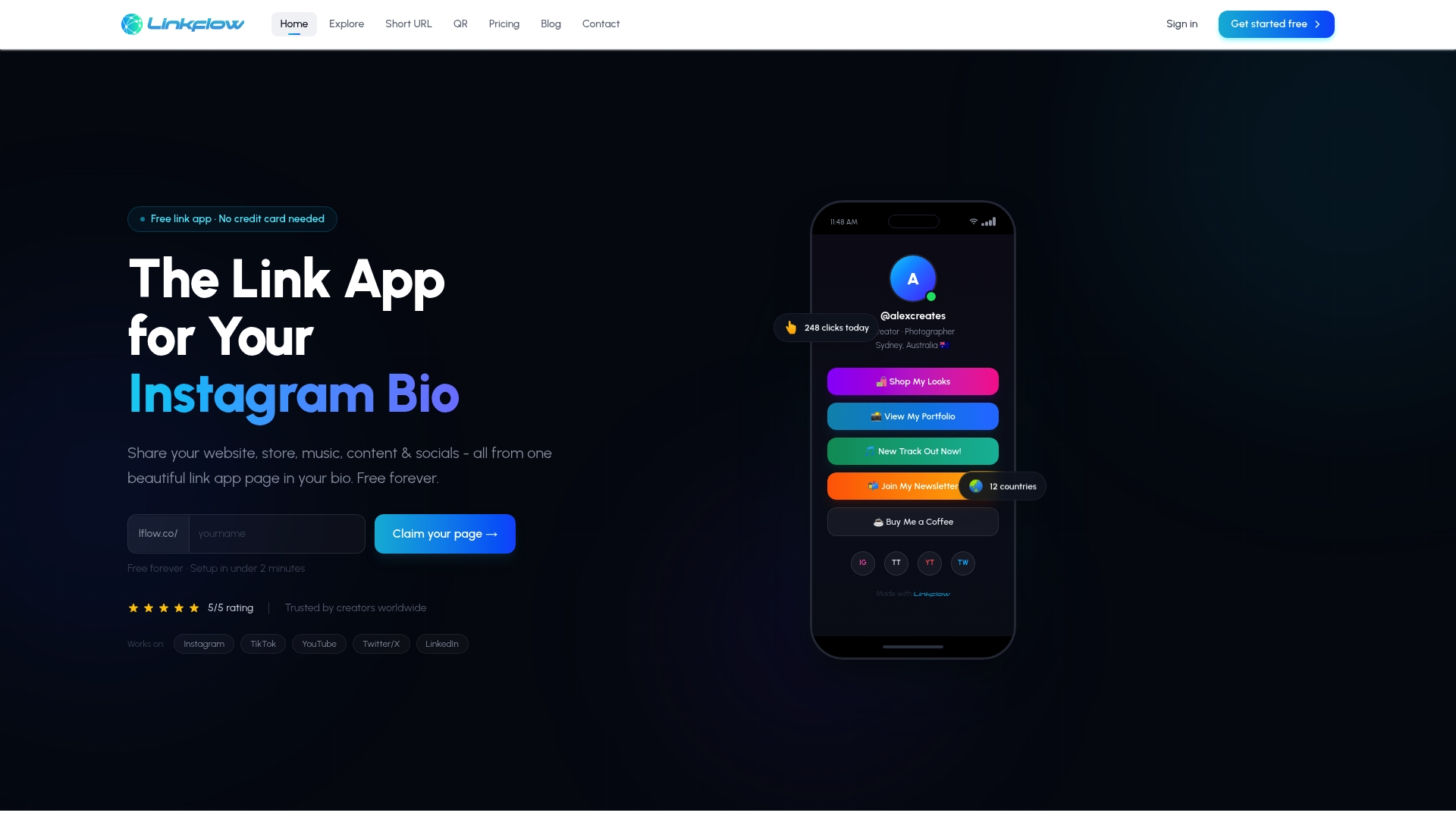
Every optimization tactic in this article depends on one thing: a bio link that works hard. Lflow gives you a free, branded link hub that consolidates all your destinations into a single, mobile-optimized page. You can set it up in under two minutes, customize it with your colors and fonts, and track every click in real time.
For offline promotion, Lflow's free QR code generator lets you connect physical materials like business cards, flyers, and packaging directly to your optimized profile. For bio links that are clean and trackable, the free URL shortener creates branded short URLs you can drop into any platform bio and monitor through Lflow's analytics dashboard. Both tools are free and require no technical setup.
FAQ
What are the most important social profile optimization tips?
The highest-impact changes are a keyword-rich bio with a single CTA, a high-resolution profile photo, and a trackable bio link. These three elements directly affect discoverability, trust, and conversion.
Why optimize social profiles if you already have followers?
Existing followers do not protect you from algorithmic decay. Witty Playbook confirms that outdated profiles lose ranking and trust signals over time, reducing reach even for established accounts.
How often should you update your social media profile?
A quarterly audit covers most needs. Review your bio, links, pinned content, and profile photo every three months, and update your GBP whenever business details change.
Does Google Business Profile count as a social profile?
Yes. GBP functions as a public-facing profile indexed by Google Search and Maps. Completing all GBP fields improves local search visibility the same way bio optimization improves platform search visibility.
What is the best way to track bio link performance?
Add UTM parameters to every bio link and monitor results in Google Analytics 4. This shows which platform drives the most qualified traffic and where to focus your next round of profile updates.