

You've got one link. One shot to send your audience somewhere meaningful before they scroll past. Yet most creators treat that bio link as an afterthought, dropping in a generic homepage URL and wondering why their conversion numbers stay flat. The truth is, your link in bio is prime real estate, and how you use it directly shapes your growth. This article walks you through goal setting, visual optimization, creative link destinations, tool selection, and the AI trends reshaping everything so you can turn that single link into your most powerful audience touchpoint.
Table of Contents
- Define your goals and optimize for speed
- Experiment with structured layouts and smart visuals
- Get creative with link destinations and branded shortlinks
- Choose the right link in bio tool for your strategy
- Future trends: AI-powered optimization and smart automation
- Why simplicity often outperforms complexity in bio link strategy
- Turn your creative bio link ideas into real results with Linkflow
- Frequently asked questions
Key Takeaways
| Point | Details |
|---|---|
| Speed matters | A bio link page that loads in under 1.1 seconds boosts engagement and reduces bounce. |
| Visual clarity wins | Simple layouts, line breaks, and one pointer emoji can increase bio performance by 30 percent. |
| Brand your shortlinks | Using your handle or niche in links lifts click rates and conversions. |
| Choose tools wisely | Pick your bio link tool based on your top goal—traffic, sales, or customization. |
| Keep it simple | Pages with three links or less convert better for most mobile visitors. |
Define your goals and optimize for speed
Every strong link in bio strategy starts with a clear answer to one question: what do you actually want people to do? Sending traffic to your blog is a very different goal from collecting email addresses or driving product sales. When you mix too many goals without prioritizing, your audience gets confused and leaves without clicking anything.
Start by writing down your top three objectives. These might look like:
- Drive traffic to your latest YouTube video or blog post
- Grow your email list with a free resource or newsletter signup
- Generate sales from a product, course, or affiliate offer
- Build community through Discord, Patreon, or a private group
- Showcase work with a portfolio or press page
Once you know your goals, your link selection becomes obvious. You stop adding random links and start building a focused path for your audience.
Speed matters just as much as focus. A slow bio link page loses visitors before they even see your content. Load times under 1.1 seconds reduce bounce rates by 3 to 8 percent, while slower tools clocking in at 4.3 seconds can wipe out a significant share of your clicks. On mobile, where most bio link traffic lands, patience is essentially zero.
To keep your page fast, avoid themes loaded with animations or large background images. Test your bio link tool using free speed checkers like Google PageSpeed Insights. If it loads slowly on your own device, it will perform even worse on lower-end phones with weaker connections.
Understanding maximizing engagement with your bio link means pairing speed with strategic link placement from the start.

Pro Tip: Start with just three high-impact links. More options create decision paralysis for mobile users, and three clear choices consistently outperform a long, scrollable list for new visitors.
Experiment with structured layouts and smart visuals
Your bio's visual structure shapes how quickly someone decides to click. A cluttered wall of text tells the brain "this will take effort." A clean, scannable layout says "you can find what you need in two seconds." That psychological difference shows up directly in your click-through rates.
Here is what actually works when you structure your bio visually:
- Use line breaks between your bio description and your link page intro to separate ideas and make text feel breathable
- Add one emoji as a pointer (like a pointing finger or arrow) to guide the eye toward your most important link
- Put a keyword or your main offer in your display name so visitors immediately understand what you do before they read a single word of your bio
- Use a subtle brand color that ties your profile photo, link page background, and button design into one recognizable visual identity
- Match your icon or thumbnail to the topic of each link so users can identify the right destination at a glance
These changes feel small individually, but the combined effect is significant. Structured bios with line breaks, keywords in the name field, and one emoji as a pointer outperform cluttered bios by roughly 30 percent in engagement metrics.
When you think about top bio link features that move the needle, visual clarity sits right at the top. Visitors should understand your value and find their next step within three seconds of landing on your page. If they have to read carefully to figure out what to click, you have already lost most of them.
Pro Tip: Test two different layouts for one week each. Track clicks on your third link specifically. If layout B gets more clicks on the third link, it means more people are actually scrolling, which signals stronger overall engagement.
Get creative with link destinations and branded shortlinks
Most creators default to obvious destinations: their main website, their newest post, maybe a social profile. But the most effective bio links lead somewhere that feels exclusive, time-sensitive, or genuinely valuable to the specific audience arriving from that platform.
Consider these creative destination ideas:
- Lead magnets: A free checklist, template, or guide in exchange for an email address
- Secret or gated content: A page only accessible through your bio link, creating a sense of insider access
- Event signups: A webinar, live Q&A, or limited seat workshop that creates urgency
- Curated playlists or resource hubs: A collection of your best tutorials, Spotify playlist, or recommended tools
- Product drops: A limited release landing page that counts down to availability
The link destination matters, but so does how the link looks. Branded shortlinks, meaning custom URLs that include your name or a keyword, drive measurably better results than long, generic URLs. Branded shortlinks increased CTR by a median 18 percent and conversions by 9 percent in an influencer study of ten creators.
The table below shows the performance difference clearly:
| Link type | Average CTR | Average conversion rate |
|---|---|---|
| Generic shortlink | 2.1% | 1.4% |
| Branded shortlink | 2.5% | 1.5% |
| Descriptive branded link | 3.1% | 2.1% |
Understanding how to boost engagement with bio links means treating every URL as a piece of your brand, not just a technical redirect. Your multi-link bio guide strategy should build a cohesive ecosystem where every destination feels intentional.
Pro Tip: Include your handle or a short keyword in every branded URL you create. "yourcreatorname.co/freeclass" is far more trustworthy and memorable than a string of random characters.
Choose the right link in bio tool for your strategy
Your tool is the engine behind everything. Choosing the wrong one means fighting limitations instead of growing. The good news is the market now offers solid options for almost every creator type and goal.
Here is a quick breakdown of the leading tools and what they excel at:
| Tool | Best for | Speed | Ease of use | Standout feature |
|---|---|---|---|---|
| Linktree | Beginners, simplicity | Fast | Very easy | Huge template library |
| Beacons | Monetization, sales | Moderate | Easy | Built-in store and tips |
| Stan | Digital product creators | Fast | Moderate | Course and checkout features |
| Carrd | Custom design control | Fast | Intermediate | Full HTML/CSS flexibility |
| Linkflow | Balanced creators | Very fast | Very easy | Analytics + branded domains |
Linktree is best for beginners and simplicity, while Stan and Beacons work better for monetization and digital product sales. Carrd suits creators who want complete custom design control. Each tool has a clear strength.
One important nuance worth understanding: Beacons increases retention and time on page but may actually lower external click-through rates compared to tools like Linktree that focus on fast redirects. If your goal is to send people directly to an outside destination quickly, a simpler tool often beats a feature-rich page builder.
"Over-customization is a real risk. Adding too many features, colors, and widgets to your bio link page can slow it down and overwhelm visitors. Simple layouts with clear CTAs frequently convert better than highly designed pages."
When comparing Linkflow vs Linktree, the decision usually comes down to analytics depth and branded domain support. For creators who want real-time data without upgrading to paid tiers, that difference matters. Exploring all-in-one link tools can help you find the right balance between features and simplicity for your specific growth phase.
Future trends: AI-powered optimization and smart automation
The next wave of bio link tools is not just about storing links. It is about making those links work harder for you without additional manual effort on your part. AI-powered features are moving from experimental to mainstream, and early adopters are already seeing the benefits.
Here is what is coming and what is already here:
- AI-suggested link ordering: Algorithms analyze which of your links get the most clicks and automatically surface the highest performers at the top of your page.
- Personalized CTAs by visitor segment: Future tools may detect whether a visitor came from TikTok versus LinkedIn and show a different call-to-action for each audience.
- Automated A/B testing: Instead of manually swapping layouts for a week at a time, AI tools will run split tests continuously and apply the winning version in real time.
- Content expiration and scheduling: Automatically remove outdated links, schedule time-sensitive drops, and rotate seasonal content without logging in manually.
- Predictive analytics: Forecasting which link destinations will perform best based on historical data patterns and audience behavior trends.
Linktree's Creator Index uses data-driven archetypes to give creators strategic direction, and future tools are expected to push this further by auto-optimizing individual link elements. This signals a shift where the link in bio becomes less of a static page and more of a dynamic, responsive marketing asset.
For creators focused on AI for link in bio strategies, the key is to start building good data habits now. The more you track click behavior today, the better your AI-powered tools will perform when you adopt them. Clean analytics data is the foundation that makes automation actually useful.
The stat that matters here: even modest AI-driven link ordering improvements of 15 to 20 percent in click distribution can compound significantly over thousands of monthly visitors, turning a good bio link into a consistently high-performing growth channel.
Why simplicity often outperforms complexity in bio link strategy
Here is the honest take after watching thousands of creator bio link setups: the most creative strategy is usually the clearest one. We see creators spend hours customizing animations, adding eight links, experimenting with five font styles, and then wonder why their engagement dropped. The answer almost always comes back to cognitive load.
Mobile visitors make split-second decisions. They are on a small screen, likely multitasking, and they arrived from a fast-moving social feed. When your bio link page asks them to process too much at once, their brain's easiest choice is to leave. That is not a content problem or a brand problem. It is a design decision problem.
Simple 3-link pages often convert better for quick mobile traffic than complex, highly customized pages. This does not mean you should be boring. It means every creative choice you make should reduce friction, not add to it. A beautiful branded color that loads fast is creative. A layered background image that slows your page by 2 seconds is just noise.
How you support influencer audience engagement comes down to making the next step obvious and effortless. The creators consistently outperforming in bio link metrics are not the ones with the most visually complex pages. They are the ones who ruthlessly edited their layouts until only the essential, high-value elements remained.
The framework we keep coming back to: add a creative element only if it helps your audience decide faster or feel more confident about clicking. If it does neither, cut it. Creative restraint is a skill, and in the bio link space, it pays directly.
Turn your creative bio link ideas into real results with Linkflow
You have the strategy. Now you need a tool that matches your ambition without slowing you down. Linkflow makes it genuinely easy to put everything in this article into practice, from focused 3-link setups to fully branded pages with real-time analytics.
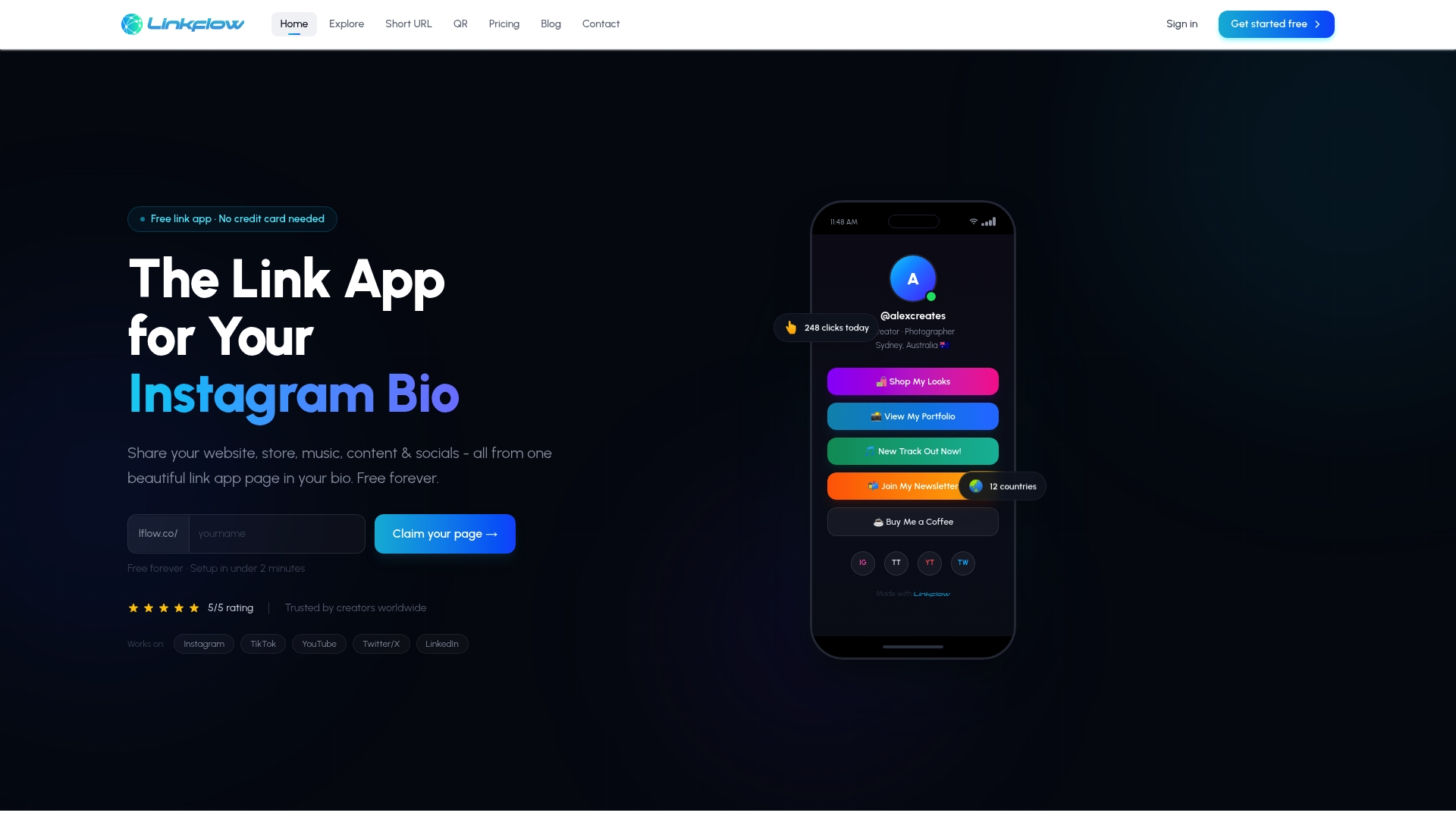
With Linkflow, you get unlimited links, free QR codes for offline promotion, and a library of ready-to-use Free Link in Bio Templates that cover every creator niche. Setup takes under two minutes, and your page is mobile-optimized from the first click. If you are currently using another tool, the Linkflow vs Linktree comparison page breaks down exactly where you gain more for less. Start building your Free Link in Bio page today and see how fast creative ideas turn into measurable results.
Frequently asked questions
What is the best type of content to link in my bio for more engagement?
Interactive content like lead magnets, exclusive event signups, limited product drops, and hidden resource pages consistently earn higher click rates than standard homepage links.
How many links should I include in my link in bio?
Three focused, high-priority links perform best for mobile users and tend to maximize conversions because they reduce decision fatigue and keep the page fast.
Do emojis and visual cues improve link in bio performance?
Yes, structured bios using one emoji as a pointer alongside line breaks and keywords outperform plain text bios by approximately 30 percent.
What's the difference between Linktree and Beacons for bio links?
Linktree is built for straightforward traffic redirection with a simple user experience, while Beacons increases on-page retention and supports direct sales features, though it may reduce external click-through rates.
Will AI tools soon optimize my link in bio automatically?
Yes, AI-powered creator tools are already using data-driven insights to suggest link order and copy, with full automatic optimization expected to become a standard feature across leading platforms.