

The most effective influencer marketing playbook for 2026 prioritizes long-term creator relationships, performance measurement, creator commerce, and creator-led paid amplification. Here are the eight practices that move the needle most:
- Long-term ambassador programs over one-off posts — sustained creator relationships build audience trust that single activations can't replicate
- Creator commerce and affiliate models — TikTok Shop, Instagram Shopping, and YouTube Shopping turn content directly into revenue with trackable conversion events
- Product seeding — low-cost, high-authenticity content generation that feeds both organic and paid pipelines
- Creator-led paid amplification (whitelisting) — running paid ads from creator accounts outperforms brand-account ads on cost-per-click and conversion rate
- Multi-touch attribution and measurement architecture — UTMs, promo codes, pixel events, and post-purchase surveys set up before the first post goes live
- AI-enabled discovery and operations — faster brand-fit scoring, contract management, and content rights tracking at scale
- Content rights and repurposing — securing usage rights upfront turns creator assets into paid ads, email, and product pages without additional production cost
- Audience-fit over raw reach — relevance and cultural fit consistently outperform follower count for conversion and ROI
Your 48-hour quick start:
- Audit your last three campaigns: pull CPA, ROAS, and engagement by creator tier and identify which tier actually converted.
- Instrument your tracking stack: confirm UTM taxonomy, unique promo codes, and at least one post-purchase survey question are ready before any new post goes live.
- Pilot one micro-influencer product seeding campaign with five to ten creators, usage rights included in the agreement from day one.
Table of Contents
- Which influencer strategies actually deliver in 2026?
- How do you prove business value from creator campaigns?
- How should you select and vet creators?
- What should creator compensation and contracts look like?
- How do you brief creators without killing their voice?
- How do you scale a creator program beyond one-off campaigns?
- What tools does your 2026 influencer tech stack need?
- What does a 90-day influencer campaign plan look like?
- What global compliance rules apply beyond US FTC requirements?
- Key Takeaways
- The performance-first shift most teams are still resisting
- Lflow gives your creators a single, trackable destination
- Sources and further reading
Which influencer strategies actually deliver in 2026?
Not every strategy fits every objective. The table below maps each approach to the goal it serves best, its typical cost shape, and the platform where it performs strongest.
| Strategy | Best for | Typical cost shape | Scalability | Platform fit |
|---|---|---|---|---|
| Product seeding | Awareness, UGC pipeline | Low (product cost + shipping) | High (volume play) | Instagram, TikTok |
| Ambassador programs | Trust, consideration, LTV | Mid-high (retainer or hybrid) | Medium (relationship-intensive) | Instagram, YouTube, LinkedIn |
| Affiliate/creator commerce | Direct conversion, ROAS | Commission-based (5–20%) | High (self-scaling) | TikTok Shop, Instagram Shopping |
| Creator-led paid ads | Conversion, retargeting | Mid (creative fee + media spend) | High (paid amplification) | TikTok, Instagram, YouTube |
| Co-created content | Consideration, brand storytelling | Mid (production partnership) | Low-medium | YouTube, Instagram |
| Brand-owned creator communities | Retention, advocacy | Low ongoing (community management) | Medium | Discord, Instagram, LinkedIn |
Product seeding
Send product to creators without a payment obligation and let them post if they genuinely like it. The authenticity signal is real — audiences can tell the difference between a paid post and a creator who actually chose to feature something. The tradeoff is control: you won't get guaranteed posts, and you need volume of sends to generate a reliable content pipeline. Budget for product cost plus shipping, and always include a short one-pager with your key claim and disclosure reminder.
Ambassador programs
Long-term ambassador programs are the baseline for brands that want compounding trust. A creator who posts about your product every six to eight weeks builds a different kind of credibility than one who mentions it once. Reserve macro and mega influencers for major launches or seasonal moments; for sustained brand authority, a roster of several micro-creators on quarterly retainers typically delivers better cost-per-outcome. LinkedIn works particularly well for B2B ambassador programs where thought leadership content drives pipeline.
Affiliate and creator commerce
Platform-native shopping features — TikTok Shop, Instagram Shopping, YouTube Shopping — have compressed the path from discovery to purchase to a single tap. Commission-based affiliate structures align creator incentives directly with your revenue goals. A creator who earns 10–15% per sale has a concrete reason to optimize their content for conversion, not just views. This model scales naturally: add more creators to the roster without proportionally increasing fixed costs.
Creator-led paid amplification
Whitelisting — running paid ads from a creator's account rather than your brand account — consistently outperforms brand-account creative on engagement and conversion metrics. The creative feels native because it is native. Budget for a creative fee to the creator plus your media spend, and treat the creator's handle as a paid media asset. TikTok Spark Ads and Instagram's partnership ad format both support this natively.
Pro Tip: When you whitelist a creator's post, negotiate the amplification window upfront — 30, 60, or 90 days — and include it in the contract before any content is produced. Retroactive whitelisting negotiations almost always cost more.
For a broader look at influencer marketing tactics in 2026, the full tactical roundup covers additional format-specific approaches worth bookmarking.
How do you prove business value from creator campaigns?
Measurement is where most influencer programs break down. The fix isn't a better dashboard — it's building the tracking architecture before the first post goes live. A multi-layered stack combining UTMs, unique promo codes, affiliate links, pixel events, and post-purchase surveys is the only reliable way to triangulate attribution across devices and dark social.
KPI mapping by objective
| Objective | Primary KPI | Secondary KPI | Data source |
|---|---|---|---|
| Awareness | Share of Voice, brand lift | Reach, impressions | Platform analytics, survey tools |
| Consideration | Traffic, video completion | Saves, profile visits | GA4, platform analytics |
| Conversion | CPA, ROAS | Add-to-cart rate, promo redemptions | E-commerce, affiliate dashboard |
| Retention/LTV | Repeat purchase rate, CLV | Community growth | CRM, e-commerce |
Incrementality and holdout testing
Holdout tests — withholding creator content from a matched control group — give you the cleanest read on whether influencer spend is actually driving incremental sales or just capturing demand that would have converted anyway. Run holdouts when you have enough volume to split audiences meaningfully (typically a large number of addressable users per cell). For smaller programs, media-mix modeling or incremental ROAS calculations using before/after promo code redemption rates are practical alternatives.
Share of Voice is an underused signal. Tracking your brand's share of relevant social conversation before, during, and after a campaign tells you whether creator activity is actually moving your position in the market, not just generating impressions.
Pre-launch measurement checklist
Before any creator publishes, confirm:
- UTM parameters are live and mapped to GA4 goals
- Each creator has a unique promo code or affiliate link
- Pixel events (view content, add to cart, purchase) are firing correctly
- Post-purchase survey includes one attribution question ("How did you hear about us?")
- Baseline Share of Voice is captured for the campaign's key topics
Pro Tip: Attribution leakage is highest on mobile, where users switch between apps and browsers. A post-purchase survey question captures the conversions your pixel misses — treat it as a required element, not an optional add-on.
How should you select and vet creators?
Reach is the wrong starting point. Audience trust and cultural fit predict conversion far better than follower count, and a creator with 15,000 highly engaged followers in your exact niche will often outperform one with 500,000 broadly distributed ones.

Building your Ideal Influencer Profile
Define these elements before you open any discovery tool:
- Audience demographics: age range, location, income bracket, and purchase behavior that match your customer profile
- Topical alignment: the creator's consistent content themes, not just their most viral posts
- Content cadence: posting frequency and format mix (video vs. static vs. Stories)
- Conversion signals: do they include CTAs? Do their followers click links and buy?
- Platform primary: where does their audience actually engage, not just follow?
Vetting workflow
Micro and nano creators consistently deliver higher engagement rates and lower acquisition costs than mega creators, but they require more diligence to vet at scale. Work through this sequence:
- Pull platform analytics: audience location breakdown (aim for the majority in your target market), age/gender split, and follower growth curve
- Check engagement rate against tier benchmarks: nano (1k–10k) should clear 4–8%; micro (10k–100k) should clear 2–4%; macro (100k–1M) typically runs 1–2%
- Read 20–30 recent comments for sentiment, specificity, and authenticity — generic "great post!" clusters are a red flag
- Verify follower growth history: sudden spikes of 10,000+ followers in a week without a viral post are a strong signal of purchased followers
- Review past brand partnerships for category conflicts or disclosure violations
Red flags to walk away from
- Engagement rate significantly below tier average with no obvious explanation
- Audience concentrated in markets you don't sell in (common with purchased followers)
- Inconsistent disclosure practices on past sponsored content
- Comments that are overwhelmingly emoji-only or generic phrases
- No evidence of link clicks or purchase behavior in their audience
Creator vetting checklist (copy into your brief):
- Audience location 60%+ in target market
- Engagement rate meets expected tier benchmark
- Comment sentiment is specific and genuine
- No suspicious follower spikes in recent months
- Past disclosures are FTC-compliant
- No active category exclusivity conflicts
What should creator compensation and contracts look like?
Compensation models
The compensation spectrum runs from flat fee (predictable cost, no performance upside) to commission-only (zero fixed cost, harder to recruit quality creators) to hybrid base plus performance bonus. Hybrid structures are the rising standard because they align creator incentives with brand outcomes without asking creators to absorb all the risk.
When to use each model:
- Flat fee: awareness campaigns, brand storytelling, or when you need guaranteed deliverables on a fixed timeline
- Hybrid (base + commission/bonus): conversion-focused campaigns, ambassador programs, affiliate-adjacent activations
- Commission-only: mature affiliate programs with proven conversion rates and creators who already trust the brand
Typical US rate ranges by tier (2026)
| Tier | Followers | Instagram post | TikTok video | YouTube integration |
|---|---|---|---|---|
| Nano | 1k–10k | $50 | $25 | $100–$500 |
| Micro | 10k–100k | $300 | $200 | $500 |
| Macro | 100k–1M | $15,000 | $10,000 | $30,000 |
| Mega | 1M+ | $15,000+ | $10,000+ | $30,000+ |
Rates vary by niche, exclusivity, usage rights, and deliverable complexity. These are directional benchmarks, not guarantees.
Essential contract clauses
Every influencer contract needs these elements before signature:
- Deliverables and timeline: exact post count, format, platform, and publish dates
- Usage rights: duration (12–24 months is standard), channels (paid ads, email, website), and territory
- Exclusivity scope: category and duration (30–90 days is typical for micro; 6–12 months for ambassadors)
- FTC disclosure language: the FTC requires clear and conspicuous disclosure of material connections — specify the exact disclosure wording in the contract, not just a general obligation
- Content approval window: 48–72 hours for review; define what constitutes approval by silence
- Payment terms: net-15 or net-30 after content approval, with milestone payments for longer programs
- Kill-switch clause: right to request content removal if a creator's conduct creates reputational risk, with defined notice period
Statistic callout: Hybrid compensation models — base fee plus performance bonus — are a rising best practice for 2026, with trend guidance from Sprout Social recommending this structure to encourage creator-driven conversions while maintaining predictable cost floors.
How do you brief creators without killing their voice?
The brief is where most brand-creator relationships go wrong. Over-specified briefs produce stiff, inauthentic content. Under-specified ones produce content that misses the point entirely. The goal is a one-page document that gives creators everything they need and nothing they don't.
Brief template
Campaign: [Campaign name and brand] Audience: [One-line description: e.g., "US women 25–40 interested in skincare and wellness"] Goal: [One sentence: e.g., "Drive trial of Product X among new-to-brand customers"] Key claim: [The single most important thing to communicate] Required elements:
- Disclosure: "#ad" or "Paid partnership with [Brand]" clearly visible
- CTA: [Specific action, e.g., "Link in bio for 15% off"]
- Product shown: [Usage context, if required]
Deliverable spec: [Format, length, platform, publish date] Do-not-touch list: [Competitor mentions, claims you can't substantiate, brand elements that must not be altered] Brand assets: [Link to shared folder with logos, product images, brand guidelines]
Approval workflow
Giving creators concise briefs and genuine creative freedom is the core best practice — specify goals and mandatory elements, then let them adapt the message in their own voice. A rigid script produces content that their audience immediately recognizes as inauthentic.
Recommended SLAs:
- Creator submits draft: 7 days before publish date
- Brand review window: 48 hours (72 for complex campaigns)
- Creator revision window: 24 hours
- Final approval: 24 hours before publish
Limit feedback to mandatory elements only. If the disclosure is correct, the key claim is present, and the CTA is included, the creative execution is the creator's call.
Content rights guidance
Negotiate usage rights before production begins, not after. Securing repurposing rights upfront lets you turn creator content into paid ads, email creative, and product page assets without additional production cost or retroactive negotiation. Standard practice:
- Organic-only rights: included in base fee
- Paid amplification rights (30–90 days): add 20–50% to base fee
- Extended paid rights (6–12 months): negotiate separately, often 50–100% of base fee
- Exclusivity: priced on top of usage rights, not bundled
Pro Tip: Ask for a "raw footage" clause in ambassador contracts — the right to receive unedited video files. This gives your team the flexibility to cut platform-specific versions without going back to the creator for reshoots.
Collaboration rules that protect both sides:
- Share the brief, not a script — give the destination, not the directions
- Approve mandatory elements only; never rewrite a creator's caption
- Confirm disclosure language in writing before publish, not after
- Provide brand assets in the creator's preferred format (vertical video, square, etc.)
- Give feedback in one consolidated round, not in multiple back-and-forth messages
- Confirm publish date and time in the contract, not just the week
For guidance on brand alignment and creative controls, the social media branding guide covers how to maintain consistency without over-policing creator output.
How do you scale a creator program beyond one-off campaigns?
The path from pilot to scalable channel follows a predictable arc: test with a small roster, identify what works, systematize the operations, then amplify with paid media.
Program architecture
Phase 1 — Pilot (weeks 1–8): Five to ten creators, one campaign, one objective. Measure everything. Identify your top two or three performers by CPA or ROAS, not by engagement rate alone.

Phase 2 — Roster building (weeks 8–16): Expand to a moderate number of creators based on pilot learnings. Introduce ambassador agreements for top performers. Build a content asset repository with rights-cleared assets tagged by creator, platform, and usage window.
Phase 3 — Ambassador program (months 4–9): Formalize quarterly retainers with your top creators. Establish a content calendar, a creator briefing cadence, and a shared Slack or Discord channel for real-time communication.
Phase 4 — Scaled paid amplification (months 6+): Whitelist top-performing organic posts. Run creator-led paid ads alongside ambassador content. Feed rights-cleared assets into email, paid social, and product pages.
Operational playbook
A scalable program needs infrastructure, not just relationships:
- Creator CRM: track contact info, rates, past deliverables, performance history, and contract status in one place (Airtable, Notion, or a dedicated influencer platform)
- Contract library: standardized templates with pre-approved clauses; only customize deliverables, rates, and exclusivity scope per creator
- Content asset repository: organized by creator, campaign, platform, and rights expiration date — critical for avoiding usage violations
- Payment automation: net-15 or net-30 payments triggered by content approval, not manual invoicing
- Quarterly reviews: performance by creator, tier, and platform; roster decisions based on data, not relationships
Repurposing guidelines
Rights-cleared creator content can feed multiple channels simultaneously. A 60-second TikTok becomes a 15-second paid social ad, a GIF for email, a testimonial block on a product page, and a Reel. The production cost is already sunk — the only variable is whether you secured the rights upfront.
Always tag assets with their rights expiration date. Running a paid ad with expired usage rights is a contract violation that can damage creator relationships and expose the brand to legal risk.
Staffing
A one-to-two person team can manage a roster of 20–30 creators with the right tools and templates. Beyond that, dedicated roles matter:
- Program manager: creator relationships, briefs, approvals, and roster decisions
- Contract and rights specialist: usage tracking, payment processing, and compliance
- Analytics owner: measurement architecture, reporting, and optimization recommendations
Enterprise programs running 100+ creators typically add a content reuse specialist who manages the asset library and coordinates with paid media teams.
What tools does your 2026 influencer tech stack need?
The stack breaks into four functional layers. You don't need every category on day one — start with tracking and link management, then add discovery and collaboration tools as the program scales.
| Layer | Function | Key features to evaluate |
|---|---|---|
| Discovery | Find and vet creators | Audience demographics, brand-fit scoring, AI-powered search, engagement authenticity |
| Collaboration & contracts | Brief, approve, pay | Contract templates, rights tracking, approval workflows, payment automation |
| Tracking & analytics | Measure attribution | UTM management, affiliate dashboards, server-side pixel events, GA4 integration |
| Link management | Reduce friction, improve attribution | Link-in-bio pages, short URLs with click analytics, QR code generation |
Discovery and vetting
AI speeds discovery and vetting through brand-fit scoring and natural-language search, but it doesn't replace manual context checks for authenticity and creative voice. Use AI to generate a shortlist; use human judgment to make the final call. Look for platforms that surface audience location breakdowns, historical engagement trends, and past brand partnership data — not just follower counts.
Tracking and analytics
Your tracking layer needs to connect to your e-commerce platform (Shopify, WooCommerce), GA4, CRM, and paid media accounts. Server-side pixel events are increasingly important as browser-based tracking degrades with cookie deprecation. Affiliate dashboards should generate unique links per creator automatically, not require manual setup for each activation.
For a deeper look at when and why influencer tools matter, the full tools guide covers platform-specific trade-offs worth reviewing before you commit to a stack.
Link management: link-in-bio, short URLs, and QR codes
Link-in-bio and short-link tools materially reduce friction and improve cross-device attribution when creators use them in captions or profile pages. A creator who sends followers to a branded short link — rather than a raw product URL — gives you click data, device data, and conversion path data that a plain URL can't capture.
QR codes extend the same attribution logic to offline touchpoints: event appearances, packaging inserts, and print. QR codes in influencer campaigns bridge the gap between a creator's in-person presence and your digital funnel, and each code can carry UTM parameters that feed directly into GA4.
Integration checklist:
- Link-in-bio platform connected to GA4 via UTM parameters
- Short links generating unique click data per creator per campaign
- QR codes linked to campaign-specific landing pages, not your homepage
- Affiliate dashboard synced with e-commerce for real-time conversion tracking
What does a 90-day influencer campaign plan look like?
Timeline and milestones
Weeks 1–2 — Discovery and brief
- Finalize campaign objective, KPIs, and budget allocation
- Complete creator vetting and shortlist (10–20 candidates)
- Send outreach and negotiate terms
- Instrument tracking stack (UTMs, promo codes, pixel events)
Weeks 3–4 — Contracting and onboarding
- Execute contracts with usage rights and disclosure language confirmed
- Brief creators and share brand assets
- Confirm publish dates and approval workflow
Weeks 5–8 — Pilot launch
- First wave of content goes live
- Monitor daily: promo code redemptions, link clicks, engagement rate
- Day 30 go/no-go: if CPA is within 20% of target, continue; if not, pause and diagnose
Weeks 9–10 — Optimization sprint
- Whitelist top-performing organic posts for paid amplification
- Adjust creator mix based on performance data
- Day 60 checkpoint: confirm ROAS and Share of Voice movement
Weeks 11–12 — Scale and repurpose
- Expand roster with additional creators in top-performing tier
- Feed rights-cleared assets into email, paid social, and product pages
- Day 90 review: full performance report, ambassador program decisions, Q3 budget recommendation
Budget benchmarks
| Budget tier | Monthly spend | Creator mix | Expected outputs |
|---|---|---|---|
| Pilot budget tier | $5,000 | 5–10 nano/micro | 10–20 posts, baseline attribution data |
| Mid budget tier | $20,000 | 15–25 micro/macro | 30–50 posts, whitelisting, ambassador candidates |
| Higher budget tier | $50,000+ | a sizable number of creators across tiers | Full-funnel program, paid amplification, repurposed assets |
- Weeks 3–4: — Contract with usage rights and FTC disclosure language confirmed in writing
What global compliance rules apply beyond US FTC requirements?
US-based teams running campaigns with international creators or targeting audiences outside the US need to account for disclosure and data regulations that differ significantly from FTC rules.
European Union
The EU's Digital Services Act (DSA) and existing consumer protection directives require that commercial communications be clearly identifiable. Creators targeting EU audiences must disclose paid partnerships in a way that is "clear and unambiguous" — similar in spirit to FTC requirements but enforced at the platform level through the DSA's transparency obligations. The EU also applies GDPR to any data collected from EU users through tracking pixels, affiliate links, or post-purchase surveys. If your tracking stack collects data from EU visitors, you need a lawful basis for processing and a compliant cookie consent mechanism.
United Kingdom
The UK's Advertising Standards Authority (ASA) and the Competition and Markets Authority (CMA) enforce disclosure rules that are among the strictest globally. The ASA requires that paid content be labeled with "#ad" or "Ad:" at the beginning of a caption — not buried in hashtags or placed after a "more" truncation. The CMA has pursued enforcement actions against influencers and brands for inadequate disclosure, including formal undertakings and public naming.
Canada
The Competition Bureau of Canada requires that material connections between brands and creators be disclosed clearly. The standard is functionally similar to FTC guidance, but enforcement has historically focused on misleading representations rather than disclosure format specifically.
Key cross-border compliance principles
- Disclose in the language of the audience, not just English, when creators post in multiple languages
- Platform-level tools (Instagram's "Paid partnership" label, TikTok's "Promotional content" toggle) satisfy disclosure requirements in most markets but should be used alongside caption disclosure, not instead of it
- Data collection from non-US users triggers GDPR (EU/UK), PIPEDA (Canada), and other regional frameworks — confirm your tracking stack's data processing agreements cover each relevant market
- Consult qualified legal counsel for campaigns running in multiple jurisdictions; this overview is general information, not legal advice, and rules change frequently
For teams tracking 2026 social media platform shifts that affect where audiences are reachable, the platform landscape is shifting fast enough that compliance obligations are moving with it.
Key Takeaways
The most effective influencer marketing programs in 2026 are built on measurement-first architecture, long-term creator relationships, and content rights secured before the first post goes live.
| Point | Details |
|---|---|
| Measure before you launch | Instrument UTMs, promo codes, and post-purchase surveys before any creator publishes — attribution built retroactively is unreliable. |
| Prioritize relevance over reach | Micro and nano creators deliver higher engagement rates and lower acquisition costs than mega creators for most conversion objectives. |
| Secure usage rights upfront | Negotiate repurposing rights in every contract; rights-cleared assets can feed paid ads, email, and product pages without additional production cost. |
| Use hybrid compensation | Base fee plus performance bonus aligns creator incentives with brand outcomes and is the rising standard for ambassador programs. |
| Lflow for link management | Lflow's link-in-bio pages, short URLs with click analytics, and QR code generator reduce attribution friction and give creators a single branded destination to drive traffic. |
The performance-first shift most teams are still resisting
The conventional wisdom in influencer marketing has long been that reach is the primary currency. Pick the biggest creator you can afford, get the impression count up, and trust that awareness will eventually convert. That model made sense when measurement was genuinely hard. It doesn't anymore.
The brands winning in 2026 have reorganized their influencer programs the same way they reorganized paid search a decade ago: around measurable outcomes, not vanity metrics. They treat creator content as a performance asset, not a PR activation. They negotiate usage rights the way a media buyer negotiates inventory. They run holdout tests. They whitelist. They build ambassador rosters the way a sales team builds a pipeline.
What's underestimated is how much of this shift is operational, not strategic. Most marketing teams already know they should be measuring incrementality and securing content rights. The gap is in the systems: the contract templates, the tracking stack, the content asset repository, the rights expiration calendar. Strategy without infrastructure produces one good campaign and then chaos.
The other thing most guides won't say directly: creator commerce is not a TikTok-specific trend. It's a structural change in how consumers discover and buy products. The brands that treat social commerce as a channel to experiment with in 2026 will be playing catch-up in 2027. The ones building creator-commerce infrastructure now — affiliate programs, creator storefronts, whitelisted paid creative — are building a durable acquisition channel, not running a campaign.
Build the measurement architecture first. Then give creators genuine creative freedom within a tight brief. The ROI follows from those two things more reliably than from any other variable.
Lflow gives your creators a single, trackable destination
Every influencer campaign eventually runs into the same friction point: a creator has multiple links to share — your product page, a discount code landing page, a sign-up form — and Instagram or TikTok gives them one bio slot to work with. That's where attribution breaks down and conversions get lost.
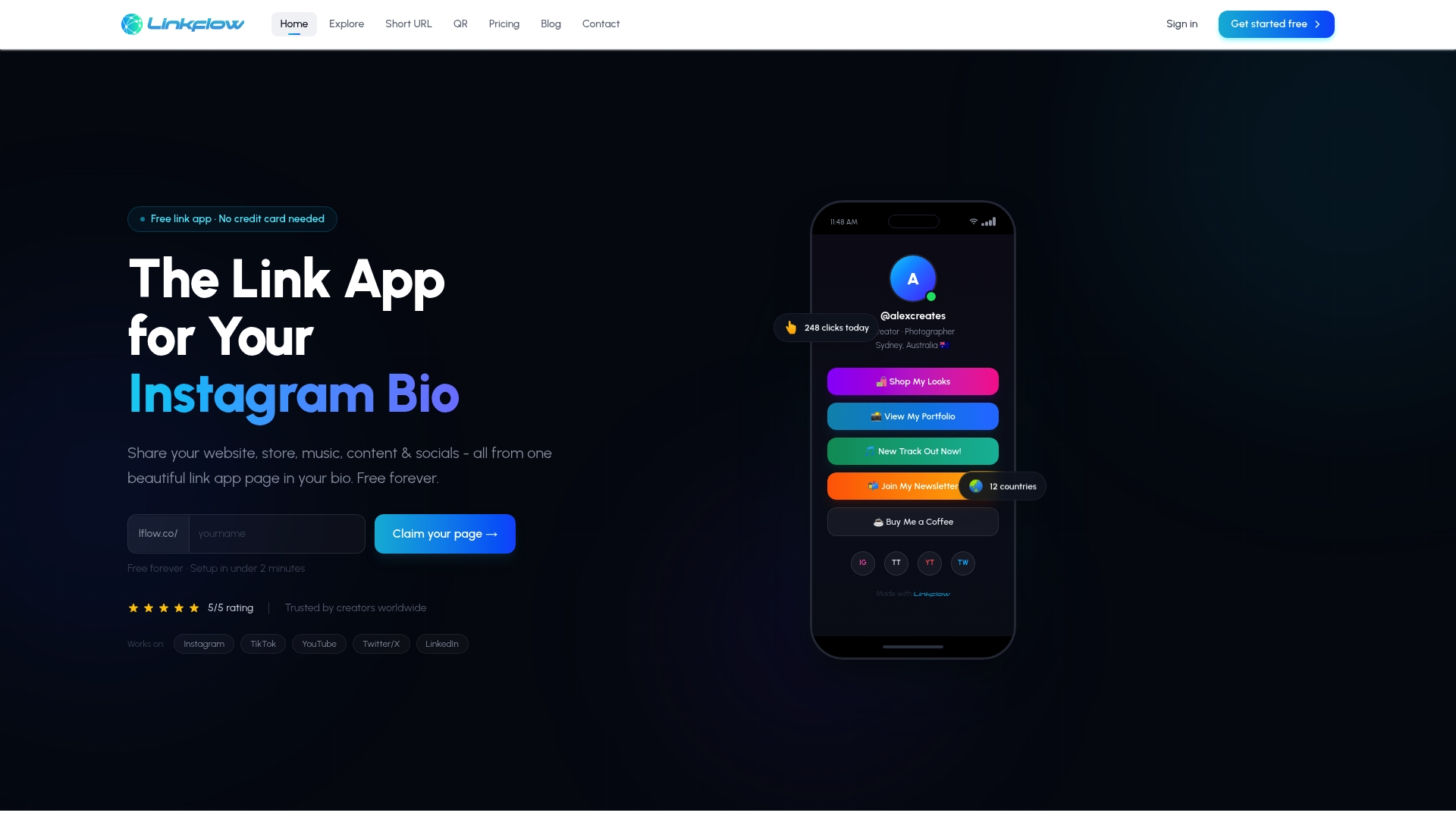
Lflow solves this directly. Creators build a branded link-in-bio page in under two minutes, consolidating every campaign destination into one clean, mobile-optimized URL. Each link on that page carries its own click analytics, so you can see exactly which destination drove traffic — not just that someone clicked the bio link. Lflow's short URL generator creates unique trackable links per creator or per campaign, feeding clean data into GA4 without manual UTM setup. And the built-in QR code generator extends the same attribution logic to offline touchpoints: event appearances, packaging, and print. Start with a free account and have your first creator landing page live before your next campaign brief goes out.
Sources and further reading
The sources below back the claims and frameworks in this guide. Each one is worth reading in full for the benchmarks, platform notes, and measurement tactics they contain.
-
Sprout Social: Influencer Marketing Trends 2026 — Platform-level data on micro/nano creator performance, social commerce adoption, AI in discovery, and hybrid compensation trends. The most comprehensive benchmark source for 2026 planning.
-
Later: How to Measure Influencer Marketing — Detailed measurement architecture guidance covering UTM taxonomy, promo codes, affiliate links, and post-purchase surveys. Use this to build your pre-launch instrumentation checklist.
-
Influencer Marketing Hub: Measure Influencer Marketing Success — Covers Share of Voice as a market-share signal and incrementality approaches. Useful for teams that need to defend influencer spend to finance or leadership.
-
ContentStudio: Influencer Marketing — Audience trust and cultural fit as conversion drivers; practical guidance on relevance-over-reach creator selection.
-
Hootsuite: Influencer Marketing — Brief structure and creative freedom best practices; the source for the "concise brief + creator voice" framework used throughout this guide.
-
Influee: Influencer Marketing Guide 2026 — Long-term ambassador program guidance, tier benchmarks, and content repurposing ROI. Strong on operational patterns for scaling programs.
-
FTC Penalty Offenses — Primary source for US disclosure requirements. Review before finalizing any contract's disclosure language clause.
-
WFA: More Than Half of Multinational Brands Plan to Boost Influencer Market Spend — Global spend intent data from the World Federation of Advertisers; useful context for budget justification conversations.
-
Lflow: How Bio Links Power Influencer Audience Engagement — Use cases and data on how link-in-bio pages improve engagement and attribution for creator campaigns.
-
Influencer Marketing Strategies That Drive Real Brand Growth — Third-party analysis on strategy and growth tactics; a useful complement to the strategies overview section.