

Every link you share is a question waiting to be answered. Did anyone click it? Who clicked it? Where were they coming from, and what did they do next? What is link tracking if not the system that turns those questions into answers you can actually use? If you have ever wondered whether your email campaign outperformed your social posts, or which channel is driving real conversions versus empty traffic, link tracking is the mechanism that tells you. This guide breaks down how it works, how to implement it correctly, and how to apply it to make smarter marketing decisions.
Table of Contents
- Key takeaways
- How link tracking works
- Best practices and common pitfalls
- Link tracking vs. page analytics
- Applying link tracking to real campaigns
- What most marketers get wrong about link tracking
- Start tracking smarter with Lflow
- FAQ
Key takeaways
| Point | Details |
|---|---|
| Link tracking definition | Link tracking records who clicks your links, when, where, and from what source. |
| UTM parameters matter | Using consistent UTM tags across campaigns prevents data fragmentation and attribution errors. |
| Branded domains build trust | Branded tracking domains improve email deliverability and increase click confidence. |
| Combine with page analytics | Link tracking alone misses on-site behavior; pairing it with tools like GA4 gives full funnel visibility. |
| Placement drives performance | Links placed in the first 20% of content consistently earn higher click-through rates. |
How link tracking works
Link tracking is the practice of recording data about every click on a URL before the visitor reaches the destination page. The mechanics are simpler than most people expect. When a user clicks a tracked link, the request passes through a tracking server that logs the click data including the time of click, device type, geographic location, and referral source, and then redirects the visitor to the intended destination. That whole process happens in under 50 milliseconds, so users never notice any delay.

UTM parameters: the language of attribution
UTM parameters are short tags appended to a URL that tell your analytics platform where traffic came from. There are five of them, though three are the ones you absolutely must use.
| Parameter | What it tracks | Example value |
|---|---|---|
| utm_source | Where the traffic originates | newsletter, instagram, google |
| utm_medium | The marketing channel type | email, social, cpc |
| utm_campaign | The specific campaign name | spring_sale_2026 |
| utm_term | Paid keyword (optional) | running_shoes |
| utm_content | Ad variation for A/B tests (optional) | banner_v2 |
When these tags are in place, platforms like Google Analytics 4 can accurately attribute traffic to the correct source, medium, and campaign rather than lumping everything under "direct" or "unknown."
Pro Tip: Always build your UTM-tagged URLs with a consistent naming tool, never by hand. Manual entry introduces typos and inconsistent casing that fragment your data before a single click is recorded.
The role of link tracking extends beyond simple click counting. Each redirect event generates a structured data record. That record flows into whatever analytics platform you connect, giving you a timestamped, device-segmented, geography-tagged picture of your audience's behavior across every channel you operate.
Best practices and common pitfalls
Understanding what link tracking does is one thing. Implementing it without creating a mess is another. Here are the most common mistakes and how to avoid them.
-
Ignore case sensitivity and pay for it later. UTM parameters are case-sensitive by default, which means "Email" and "email" register as two separate traffic sources in your reports. Enforce lowercase across every UTM value your team creates.
-
Tag your internal links and destroy your attribution. Placing UTM parameters on links that point from one page of your own website to another resets the original traffic source. A visitor who arrived from your paid ad will suddenly look like they came from your internal newsletter. Never tag internal links.
-
Use generic tracking domains and lose trust. Poorly branded tracking links reduce deliverability and raise spam flags. A link from trk247.io inspires far less confidence than one from links.yourbrand.com. Branded tracking domains signal legitimacy to both email filters and your audience. For a deeper look at how this works in practice, the breakdown of link branding benefits is worth reading.
-
Count bot clicks as real engagement. Security scanners, email preview crawlers, and automated bots click links constantly. Advanced platforms filter non-human clicks using proprietary algorithms so your "Human Clicked" metrics reflect actual people, not machines.
-
Let your team manage links in separate spreadsheets. Decentralized link management leads to fragmented data, duplicate tracking parameters, and broken attribution across campaigns. Centralized systems with role-based permissions and naming conventions prevent this.
Pro Tip: Create a shared UTM naming document and treat it as a team policy, not a suggestion. One rogue naming convention from a single team member can corrupt months of campaign data.
Link tracking vs. page analytics
A common misconception is that link tracking and page analytics like GA4 are doing the same job. They are not. They are solving different parts of the same puzzle.
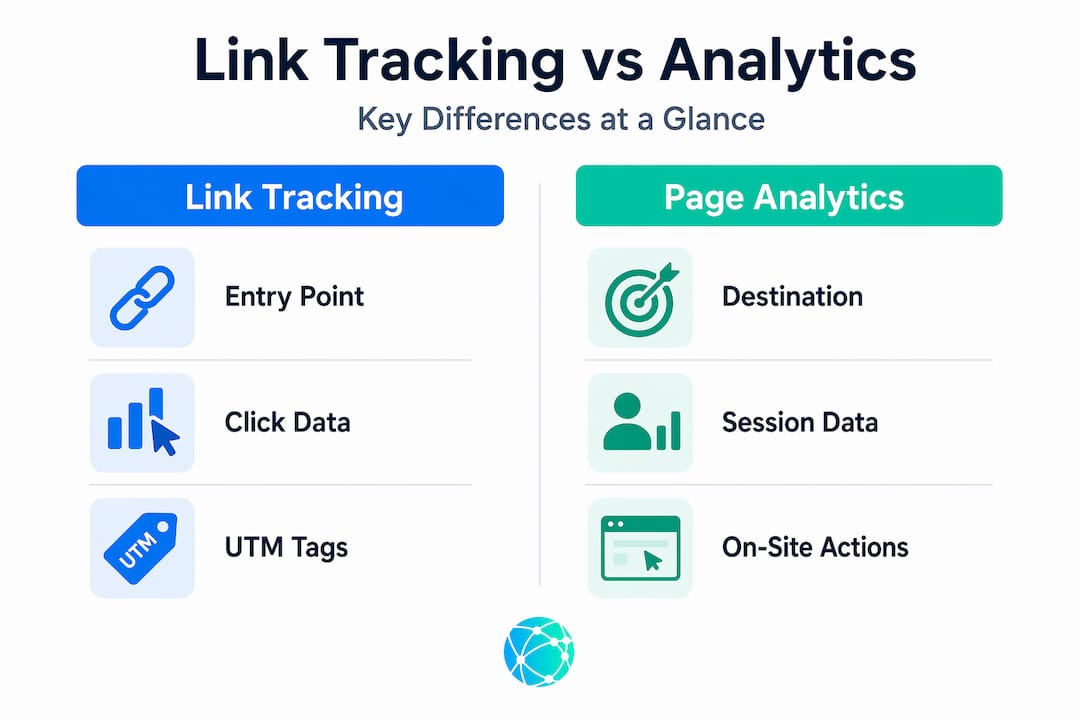
Link tracking captures entry-point data across platforms you do not control, such as email inboxes, social media feeds, third-party websites, and even physical QR codes. Page analytics capture what happens after a visitor lands on your site. One tells you how people arrived. The other tells you what they did once they got there.
| Feature | Link tracking | Page analytics (GA4) |
|---|---|---|
| Where data is captured | At the link click, before landing | On the destination website |
| Channels covered | Email, social, SMS, QR codes, ads | Pages within your own website |
| Data type | Source, device, geography, click time | Sessions, behavior flow, conversions |
| Works across external platforms | Yes | No |
| Reveals on-site behavior | No | Yes |
Relying on only one of these methods creates real gaps. If you only use page analytics, you cannot reliably distinguish whether your traffic came from Instagram, your email list, or an organic search. If you only use link tracking, you know where people clicked but not whether they bought anything. Together, they give you visibility across the full marketing funnel, from the first impression to the final conversion.
The practical lesson here: set up both, connect them properly through UTM parameters, and you will have attribution data that social media marketing teams can use to justify budget decisions with confidence.
Applying link tracking to real campaigns
Knowing how link tracking works is useful. Knowing how to apply it to your actual marketing decisions is what drives results. Here is where the role of link analytics gets genuinely valuable.
Identify your best-performing channels. When you tag every link in your email, social posts, SMS, and ads with consistent UTM parameters, you can compare click-through rates and conversion rates across channels in one dashboard. You might discover that your LinkedIn posts drive fewer clicks than Instagram, but those LinkedIn visitors convert at three times the rate. That single insight can reshape your content budget.
Use placement data to put your links where they work. Research shows that links in the first 20% of an email or piece of content earn significantly higher click-through rates than links buried at the bottom. Once you start tracking link performance by position, you can test this hypothesis on your own audience and optimize placement accordingly. A guide to improving link placement offers practical steps for applying this in your link page setup.
Feed your CRM and email platform with better data. Most CRM tools and email marketing platforms accept UTM-tagged URLs and can segment leads by acquisition source. A contact tagged with utm_source=instagram_bio who later makes a purchase gives you a clean attribution path. You can then build retargeting audiences of people who clicked specific links but did not convert, and serve them follow-up ads that are actually relevant.
Build smarter retargeting audiences. Tracked links can trigger pixel fires when clicked, which means a visitor who clicked your tracked Black Friday link automatically enters a retargeting pool. This is far more precise than targeting everyone who visited your homepage.
Pro Tip: Link tracking data is directional, not absolute. Treat it as a strong signal for decision-making, not a perfect record. Probabilistic attribution models that weigh multiple touchpoints will always tell a more accurate story than rigid last-click attribution.
For a practical walkthrough of link management setup and organization, the link management tips guide covers how to structure your tracking from the ground up.
What most marketers get wrong about link tracking
I have worked with enough marketing teams to see the same mistake repeated: they set up link tracking once, assume it is working, and never audit it again. Three months later, half their campaign data is corrupted because someone created a UTM parameter in title case, tagged an internal nav link, or switched to a new email platform that strips query strings.
The deeper issue is that most marketers treat link tracking as a feature rather than an infrastructure decision. You would not set up your CRM once and walk away. Link tracking deserves the same ongoing attention.
What I have found actually works is treating link tracking governance like an editorial style guide. It is a living document your team returns to regularly, not a one-time setup task. The teams that get the most value from their link analytics are the ones who also invest in discipline around naming, organization, and quarterly audits.
The other thing I push back on is the idea that more data means better decisions. I have seen dashboards so cluttered with tracking parameters that no one could interpret the reports. Simplicity in your tracking architecture pays off. Three clean UTM dimensions used consistently will always outperform ten dimensions applied sporadically.
Good link tracking improved attribution clarity in every campaign I have managed seriously. But the improvement came from structure and consistency, not from the technology itself.
— Axion
Start tracking smarter with Lflow
If you are ready to put these principles into practice, Lflow gives you the tools to do it without technical complexity.
With Lflow, you can create tracked short URLs that preserve all your UTM parameters, generate free QR codes that connect offline audiences to your tracked landing pages, and manage every link from a single branded hub. The platform's real-time analytics show you exactly which links are driving engagement so you can act on the data immediately. Explore free link in bio templates to build a professional, trackable link page in under two minutes and start turning every click into insight.
FAQ
What is the link tracking definition in simple terms?
Link tracking is the process of recording data about who clicks a URL, including their device, location, and referral source, before redirecting them to the destination page.
Why track link performance across marketing channels?
Tracking link performance lets you compare which channels drive the most valuable traffic, so you can allocate budget and content effort to what actually works rather than guessing.
How does link tracking work with UTM parameters?
UTM parameters are tags added to a URL that tell analytics platforms where a visitor came from. When a tracked link is clicked, three core parameters (source, medium, and campaign) are captured and passed to your analytics dashboard.
Is link tracking the same as page analytics?
No. Link tracking captures click data at the point of the link before the user arrives on your site, while page analytics capture behavior after landing. Both are needed for full-funnel visibility.
What are the main benefits of link tracking for small businesses?
Link tracking helps small businesses identify their best-performing marketing channels, understand their audience's device and location behavior, and make smarter decisions about where to invest their limited marketing time and budget.