

Most social platforms give you exactly one bio link. One. For creators and marketers juggling a YouTube channel, an online store, a newsletter, and three active promotions at once, that single URL is a real problem. That's precisely why use link aggregators has become one of the most searched questions among content creators and social media marketers. Link aggregators solve this constraint by funneling all your important destinations into one clean, shareable URL. The benefits go well beyond convenience, touching attribution, branding, audience conversion, and cross-platform consistency.
Table of Contents
- Key Takeaways
- Why use link aggregators: the core concept explained
- Benefits of link aggregators for creators and marketers
- Advanced features: deep linking, tracking, and geo-targeting
- Comparing popular link aggregation tools
- Practical tips to maximize your link aggregator page
- My honest take on link aggregators after years of watching them evolve
- Start building your link hub with Lflow
- FAQ
Key Takeaways
| Point | Details |
|---|---|
| One URL, unlimited destinations | Link aggregators let you route followers to multiple links without changing your bio. |
| Deep links recover conversions | Smart links that open native apps recover about 30% more conversions compared to in-app browsers. |
| Analytics go beyond raw clicks | Pairing bio links with UTM tags and GA4 connects click traffic to actual revenue. |
| Branding builds trust | Custom domains and branded short URLs signal professionalism and increase click confidence. |
| Regular updates drive results | Reordering and refreshing links based on live analytics keeps your page performing across campaigns. |
Why use link aggregators: the core concept explained
A link aggregator, in the social media context, is a landing page that lives behind a single URL and presents multiple links to your visitors. Think of it as a lightweight personal homepage, built specifically for one job: routing people to wherever you need them to go. Link-in-bio tools centralize your links so you never have to swap out your bio URL every time you launch a campaign.
It's worth pausing on terminology here. "Link aggregation" also appears in networking, where the IEEE 802.1AX standard combines multiple Ethernet ports into one logical connection. That has nothing to do with Instagram bios. When creators and marketers talk about link aggregators, they mean the bio link hub, not network infrastructure.
Here's what a typical link aggregator page includes:
- A centralized hub with multiple clickable links, each with its own label and destination
- Customization options like colors, fonts, themes, and custom domain support
- Click analytics showing which links get tapped and when
- Deep linking to open native apps instead of limited in-app browsers
- QR code generation for offline promotion
- Branded short URLs that reinforce your identity
The user flow is straightforward. You create your aggregator page, place the single URL in your Instagram, TikTok, or LinkedIn bio, and then update what appears on that page whenever your promotions change. Your bio URL never moves. Your audience always has a current, relevant set of options when they tap it.
Benefits of link aggregators for creators and marketers
The most obvious benefit is solving the one-link limitation, but that's just the starting point. When a follower taps your bio link, you now control what they see. You can present your latest product launch at the top, followed by a free resource, a podcast episode, and your main store. That's four conversion opportunities from a single tap.
Flexibility is another underappreciated advantage. Running a sale this weekend? Update your top link in seconds. Promoting a new collab next Tuesday? Swap it in without touching your bio. Bio links power audience engagement precisely because they remove the friction between a follower's interest and the destination you want them to reach.

Pro Tip: Put your most time-sensitive or highest-value link at the top of your aggregator page. Studies consistently show that top-positioned items capture the most clicks, so treat that first slot like prime real estate.
Here's a sharper look at the core link aggregator advantages:
- Engagement multiplier: Presenting multiple relevant options increases the chance any visitor finds something worth clicking
- Brand consistency: A custom domain and cohesive design carry your visual identity off-platform
- Attribution clarity: Instagram does not reveal individual follower identities for bio-link taps, so built-in analytics with UTM support makes attribution possible
- Cross-platform reliability: One branded URL works identically whether your audience comes from TikTok, YouTube, or a newsletter
- Zero URL fatigue: Your audience bookmarks one link. It always stays current because you update the page, not the URL.
For a marketer running campaigns across three or four platforms, this consistency alone saves hours each month and eliminates a category of errors. Nothing is worse than a broken or outdated bio link living on a post you can't edit.
Advanced features: deep linking, tracking, and geo-targeting
This is where link aggregators move from convenient to genuinely powerful. Most creators stop at the basics, which means they're leaving real performance gains on the table.
-
Deep linking for conversion recovery. When someone taps a link inside the Instagram app, the default behavior opens a stripped-down in-app browser. That browser often blocks payment flows, login prompts, and app store redirects. Smart links that open native apps instead recover significantly more conversions because the full app experience removes those blockers. For anyone selling digital products or running app installs, this alone justifies using a smart link tool.
-
Click tracking beyond UTMs. UTM parameters are useful but fragile. Some platforms strip them, others ignore them, and relying solely on UTMs creates attribution gaps you'll never know about. Link aggregator platforms fire their own tracking before any redirect happens, giving you a reliable click count regardless of what happens downstream.
-
Geo-targeting for regional relevance. Smart links dynamically route clicks based on visitor location, device type, and other metadata. An affiliate marketer promoting a product available in different regional storefronts can send US visitors to one destination and UK visitors to another, automatically. This is not a niche use case. Any creator with an international audience should be using this.
-
Retargeting pixel integration. Before a visitor even reaches their destination, a link aggregator can fire a Facebook or Google retargeting pixel. That means anyone who clicked your bio link can be served ads later, even if they bounced without converting. Tracking clicks and firing advertising pixels before redirecting is one of the most underused tactics in creator marketing.
-
A/B testing link order and copy. Some platforms let you test different link arrangements or button labels to find what drives the most clicks. If you run any kind of paid promotion driving traffic to your bio, this feature pays for itself quickly.
Pro Tip: Set up a retargeting audience from your bio link page even before you have a specific ad campaign in mind. Building that audience now costs nothing, and you'll be glad it exists when you launch a product.
Comparing popular link aggregation tools
Choosing among the best link aggregators depends entirely on your goals. The market has matured enough that different tools genuinely serve different use cases, and picking the wrong one means paying for features you'll never use or missing ones you need.
Popular link-in-bio tools differ significantly in focus. Linktree is the most widely recognized and works well for general use. Beacons targets creator commerce with built-in monetization options. Stan focuses on digital product sales and course creators. Each has a distinct ecosystem with trade-offs in SEO control, pricing structure, and integration depth.
When evaluating your options, consider these factors:
- Does it support custom domains, or are you locked to their branded subdomain?
- What does the analytics dashboard actually show? Clicks are the floor, not the ceiling.
- Can it fire retargeting pixels? This matters if you run paid ads.
- How easy is it to update links on the fly from a phone?
- What does the free tier include, and where is the paywall?
| Tool | Best for | Key strength | Limitation |
|---|---|---|---|
| Linktree | General creators | Massive adoption, easy setup | Limited analytics on free tier |
| Beacons | Creator monetization | Commerce features built-in | Learning curve for new users |
| Stan | Course and product sellers | Digital product ecosystem | Narrower platform focus |
| Lflow | Creators and marketers | Branded URLs, QR codes, analytics | Newer platform |
For creators focused on affiliate marketing or multi-platform presence, the multi-link bio approach combined with geo-targeting and pixel firing will produce meaningfully better results than a basic static list.
Practical tips to maximize your link aggregator page
Knowing how to use link aggregators effectively separates creators who see real results from those who set it up once and forget it.
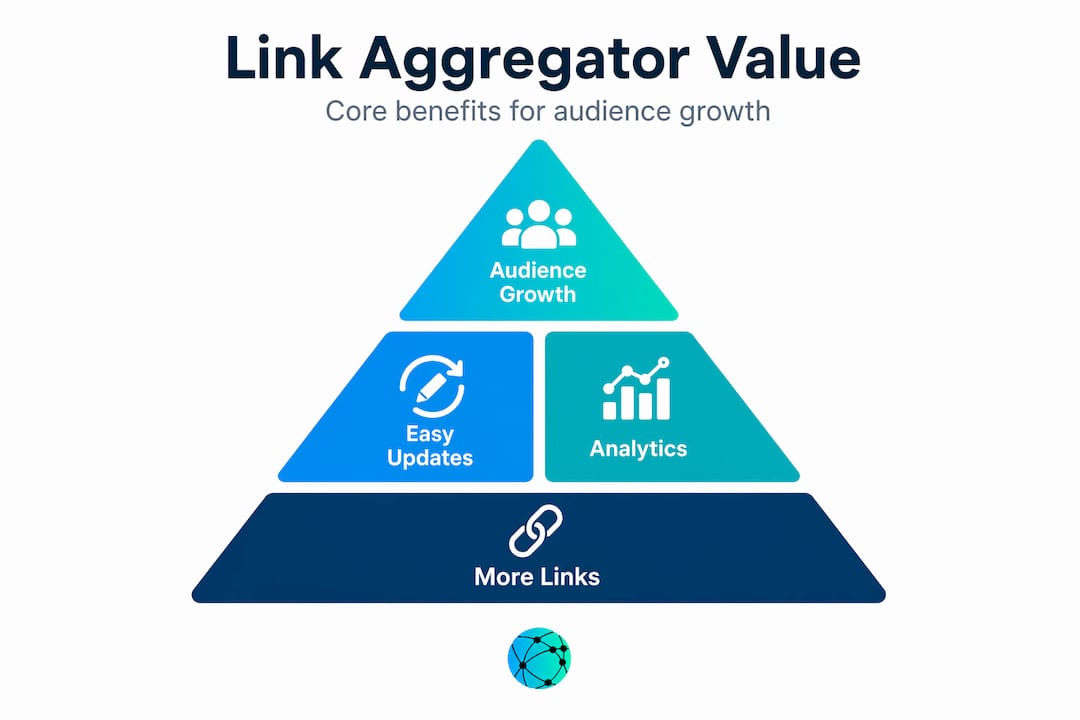
Keep your page focused. Five to seven links is usually the ceiling before visitors experience choice paralysis. Every link you add beyond your best options dilutes attention from the ones that actually matter.
Use clear, specific labels on each button. "Shop now" outperforms "Store." "Get the free guide" beats "Resources." Specificity signals exactly what a visitor gets when they click, and that removes hesitation.
Pro Tip: Review your link aggregator analytics at least once a week during active campaigns. If a link is getting zero clicks after three days, either move it down or reconsider whether it belongs on the page at all.
Connect your link tracking setup to GA4 or your preferred analytics platform using UTM parameters on every destination URL. Raw click counts on your aggregator page tell you interest. UTM-tagged destinations tell you revenue. You need both numbers to understand what's working.
Promote your bio link everywhere, not just in your profile. Add it to your email signature, mention it in video outros, print it on packaging, and generate a QR code for any physical touchpoint. A well-designed QR code linking to your aggregator page is one of the most cost-effective offline-to-online bridges a creator can use.
My honest take on link aggregators after years of watching them evolve
I've watched creators treat their link aggregator page like a filing cabinet. They add every link they've ever shared, never remove anything, and then wonder why their click-through rate drops. The most useful framing I've encountered is that your aggregator page is a router for user intent, not an archive. Its job is to direct each visitor to their best next action, not to document your entire output.
The other mistake I see constantly is confusing click volume with conversion success. Clicks show traffic interest but they do not tell you whether anyone bought, signed up, or streamed a track. I've seen creators celebrate 500 bio link clicks on a launch day, only to find three actual sales when they checked GA4. That's not a success. That's a signal that something on the destination page is broken.
As platform restrictions get tighter and algorithm reach gets more unpredictable, the bio link becomes more valuable, not less. It's one of the few consistent points of contact you fully control. My suggestion is to treat it with the same care you give your best-performing content. Update it deliberately, track it rigorously, and build the audience around it as if it's a product, not a placeholder.
— Axion
Start building your link hub with Lflow
If you've been running your social presence with a single, static bio link, you've already seen what that costs in missed clicks and fragmented campaigns.
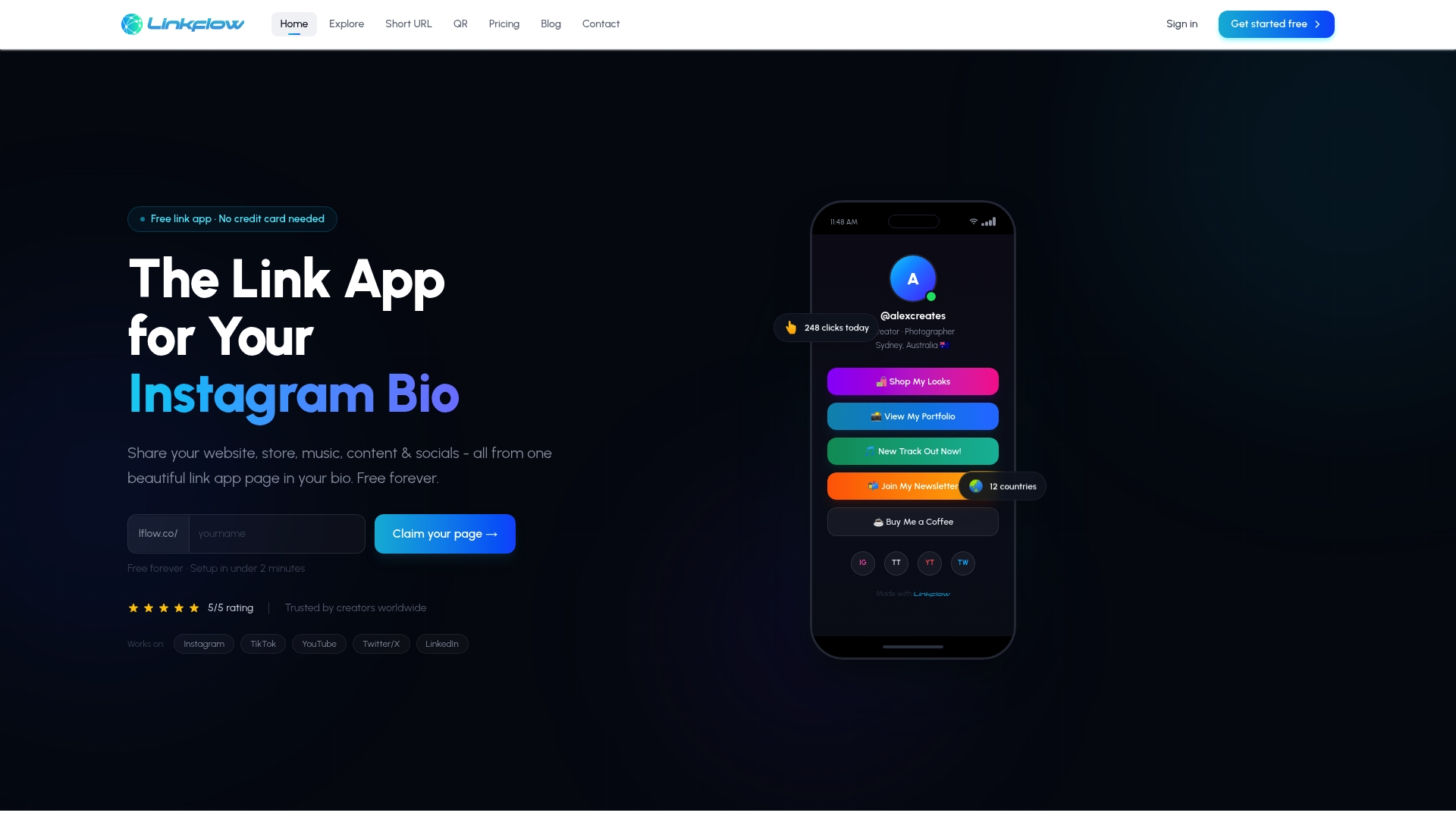
Lflow gives you a free link-in-bio page with unlimited links, a free QR code generator, branded short URLs, and a real-time analytics dashboard. Setup takes under two minutes, and you can customize everything from colors and fonts to your own custom domain. Whether you're managing an Instagram shop, a newsletter, a Spotify profile, or all three at once, Lflow consolidates everything into one clean, professional hub. Explore the pricing plans when you're ready to unlock advanced features like deep link support and pixel integration.
FAQ
What are link aggregators in social media?
A link aggregator is a landing page tool that places multiple links behind a single URL, solving the one-link limitation on platforms like Instagram and TikTok. Creators use them to route followers to stores, videos, newsletters, and other destinations from one bio link.
Why use link aggregators instead of a regular website?
Link aggregators are purpose-built for bio link traffic. They load faster on mobile, require no technical setup, and let you update links in real time without editing your bio URL.
Can link aggregators help with marketing attribution?
Yes. Most platforms include click analytics, and pairing your aggregator links with UTM parameters connects follower traffic to specific conversions in GA4 or similar tools, giving you attribution that a bare URL cannot provide.
How many links should I include on my aggregator page?
Five to seven links is the practical limit before choice paralysis sets in. Prioritize your highest-value or most time-sensitive destinations and cut anything that hasn't generated clicks in the past two weeks.
Are there free link aggregation tools available?
Yes. Several platforms offer free tiers with core features. Lflow provides a free link-in-bio page with unlimited links, QR code generation, and analytics at no cost, making it accessible for creators at any stage.