

Social media consolidation is the practice of unifying multiple social accounts, content workflows, and analytics into one central system to improve efficiency, brand consistency, and audience engagement. Brands that ignore this practice pay a real price: fragmented workflows create inconsistent messaging, lost insights, and slower response times that cost audience trust. Meta, Google, and Amazon now control 62.3% of global digital advertising spend, which means the competition for attention has never been more concentrated. The importance of social media consolidation grows directly from that reality. Winning in this environment requires a unified presence, not scattered accounts managed in isolation.
What are the main benefits of consolidating social media management?
The most immediate benefit of social media consolidation is time savings. A centralized dashboard cuts weekly posting time from 18 hours down to roughly 90 minutes. That is 16.5 hours returned to strategy, content creation, and audience building every single week.
Brand consistency is the second major gain. When your team manages Instagram, TikTok, LinkedIn, and YouTube from separate native apps, messaging drifts. One account uses a formal tone, another goes casual, and a third posts at irregular intervals. A unified system enforces a single content calendar, shared brand assets, and consistent voice across every channel.

Audience engagement improves measurably when you consolidate. 35% of consumers expect a brand to respond on social media within one hour. Meeting that standard is only realistic when all incoming messages and comments flow into one centralized feed, not scattered across five separate apps.
Consolidation also functions as risk management. Relying on a single platform is a genuine business risk. Algorithm changes on TikTok or Instagram can cut organic reach overnight. A consolidated presence spread across multiple platforms gives you stability. If one platform's reach drops, your audience on LinkedIn or YouTube absorbs the impact.
Pro Tip: Build your consolidated workflow around two or three core platforms that match your audience, then cross-post selectively. Spreading thin across eight platforms defeats the purpose of consolidation.
- Time efficiency: Reduces manual posting from 18 hours to 90 minutes per week.
- Brand consistency: Unified calendars and asset libraries prevent messaging drift.
- Faster response: Centralized feeds make sub-one-hour replies achievable.
- Risk reduction: Multi-platform presence protects against algorithm volatility.
How does social media consolidation improve workflow and productivity?
Cognitive switching is the hidden productivity killer in fragmented social media management. Jumping between native apps for Instagram, X (formerly Twitter), LinkedIn, and YouTube forces your brain to reset context each time. Cognitive switching costs reduce productivity by up to 40% when teams manage multiple platforms without a central system. That loss compounds daily across every person on your marketing team.
A centralized dashboard solves this by creating one workspace for scheduling, engagement, and analytics. Tools that offer tagged media libraries, workspace segmentation, and unified reporting let you shift from reactive posting to proactive planning. Centralized dashboards transform posting from a manual, reactive task into a data-driven strategy. You stop scrambling to fill gaps and start building content weeks in advance.
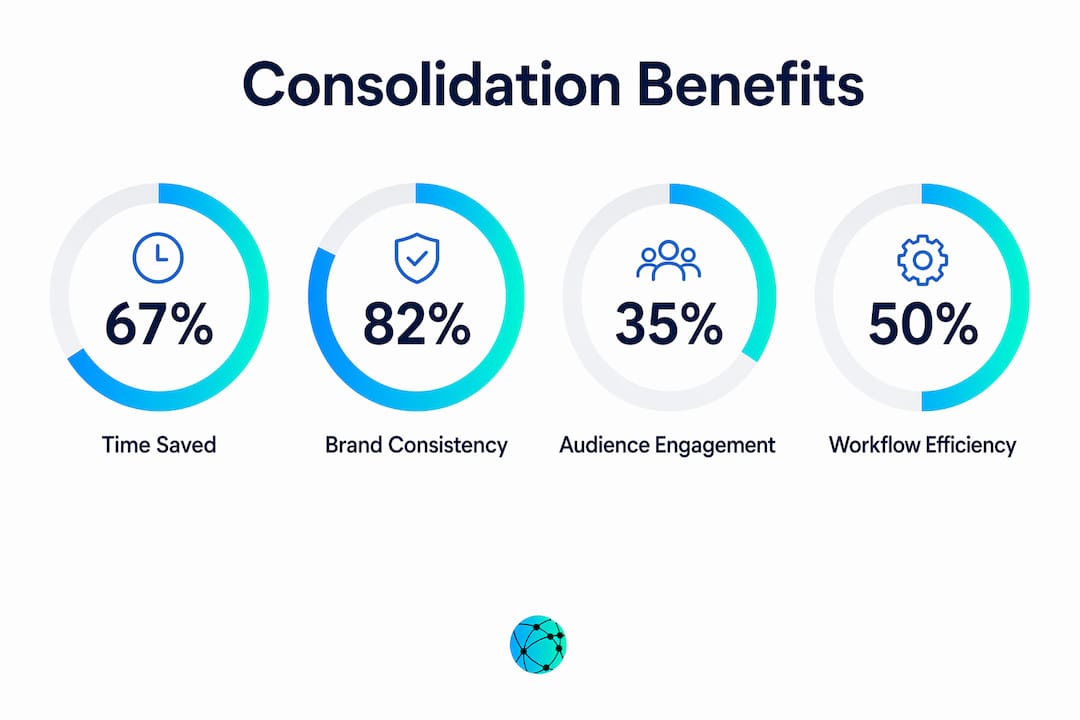
Here is a practical comparison of fragmented versus consolidated workflows:
| Workflow type | Time per week | Response speed | Analytics clarity |
|---|---|---|---|
| Fragmented (native apps) | 15–18 hours | Slow, inconsistent | Siloed per platform |
| Consolidated (central dashboard) | 90 minutes | Fast, trackable | Unified reporting |
The steps to shift from fragmented to consolidated management follow a clear sequence:
- Audit your current accounts. List every active profile, its purpose, and who manages it.
- Choose a central platform. Select a dashboard that supports all your active networks.
- Build a shared content calendar. One calendar for all platforms, with platform-specific notes.
- Tag and organize your media library. Label assets by platform, campaign, and content type.
- Set up unified analytics. Track reach, engagement, and response time from one report.
Fragmented social media workflows cause inconsistent messaging and lost insights that block accurate performance evaluation. The fix is not a one-time cleanup. It is an ongoing system built around a single source of truth.
Pro Tip: Treat your consolidated social media system like a product, not a project. Schedule a monthly audit to update your content calendar, review analytics, and adjust platform priorities.
What challenges and nuances come with consolidating social media accounts?
Consolidation does not mean identical content on every platform. Instagram rewards visual storytelling. LinkedIn rewards professional analysis. TikTok rewards short, high-energy video. A consolidated system must account for these differences, not erase them. The goal is unified management, not uniform content.
Effective consolidation requires organizing accounts into distinct workspaces to avoid digital noise. Without workspace segmentation, a single dashboard becomes as chaotic as managing five separate apps. Permissions and governance rules matter here. A social media manager for a retail brand should not have the same access level as a freelance contractor handling one campaign.
The risks of poor consolidation are real. Unsorted aggregation of all accounts into one feed creates confusion, not clarity. You end up with a louder version of the same problem. Social media fragmentation is a brand governance challenge, and consolidation only solves it when the system is designed with structure from the start.
Platform selection also requires honest evaluation. 2026 social media success depends on focusing on select platforms that match your core value proposition. Not every brand belongs on every platform. Consolidating five irrelevant accounts wastes the same time as managing them separately.
- Platform content differences: Adapt tone and format per platform even within a unified system.
- Digital noise risk: Unsorted account aggregation creates confusion, not efficiency.
- Governance gaps: Workspace permissions prevent unauthorized access and posting errors.
- Platform fit: Only consolidate accounts that serve a real audience purpose.
| Challenge | Root cause | Solution |
|---|---|---|
| Inconsistent messaging | No shared content calendar | Build one calendar with platform notes |
| Digital noise | All accounts in one unsegmented feed | Use workspace segmentation |
| Governance failures | No permission structure | Assign role-based access levels |
| Platform mismatch | Too many irrelevant accounts | Audit and close low-value profiles |
How can individuals and businesses implement social media consolidation?
Implementation starts with a clear audit, not a tool purchase. Before you pick a dashboard, you need to know exactly what you are consolidating. List every active account, its audience size, its posting frequency, and who owns it. This audit reveals redundancies, abandoned profiles, and gaps in your coverage.
Once the audit is complete, the implementation follows five steps:
- Select your core platforms. Choose two to four platforms where your audience actually spends time. For most brands, this means Instagram, LinkedIn, and one video platform such as YouTube or TikTok.
- Adopt a unified dashboard. Pick a tool that supports scheduling, engagement monitoring, and analytics across all selected platforms from one interface.
- Create a single source of truth. Build one integrated content calendar that holds all scheduled posts, campaign assets, and approval workflows.
- Automate repeatable tasks. Set up auto-scheduling for evergreen content, automated response templates for common questions, and recurring analytics reports.
- Run ongoing strategy audits. Review platform performance monthly. Drop platforms that consistently underperform. Add new ones only when there is clear audience evidence.
Automation deserves special attention here. Scheduling tools that connect to Instagram, TikTok, YouTube, and LinkedIn let you batch-create content once and distribute it across platforms with platform-specific adjustments. This is where the 90-minute weekly posting figure becomes realistic. Batching and automation together eliminate the daily scramble that burns most social media managers out.
Pro Tip: Use a link in bio page as your consolidated entry point for all platforms. One branded URL that connects to your website, store, latest content, and social profiles gives every platform a single destination to drive traffic toward.
The most common mistake in implementation is treating consolidation as a one-time project. Most failures come from setting up a system once and never revisiting it. Platforms change their algorithms. Audiences shift. New content formats emerge. Your consolidated system must evolve with those changes, or it becomes just another source of fragmentation.
Key takeaways
A unified social media system built around a central dashboard, a shared content calendar, and workspace segmentation is the most effective way to improve efficiency, brand consistency, and audience engagement across platforms.
| Point | Details |
|---|---|
| Time savings are immediate | Consolidating to a central dashboard cuts weekly posting time from 18 hours to 90 minutes. |
| Brand consistency requires structure | A shared content calendar and asset library prevent messaging drift across platforms. |
| Engagement depends on response speed | 35% of consumers expect a reply within one hour, which requires a centralized feed. |
| Consolidation is ongoing, not one-time | Treat your social media system as a living product with monthly audits and updates. |
| Platform selection matters | Focus on two to four platforms that match your audience rather than spreading across all of them. |
Why I think most brands are consolidating the wrong way
Most brands approach social media consolidation as a technology problem. They buy a dashboard, connect their accounts, and call it done. That is the wrong frame entirely. Consolidation is a governance problem first and a technology problem second.
The brands I have seen get this right share one habit: they define ownership before they define tools. Every account has a named owner. Every platform has a documented purpose. Every post goes through a shared calendar before it goes live. The tool is almost irrelevant when the system is that clear.
The brands that struggle do the opposite. They buy a tool, dump all their accounts into it, and expect the software to create order. It does not. A fragmented strategy moved into a single dashboard is still a fragmented strategy. The dashboard just makes the chaos more visible.
My honest observation from watching this space closely: the brands winning in 2026 are not the ones on the most platforms. They are the ones with the clearest presence on the fewest platforms, managed from a single system with real accountability. Consolidation is not about doing more. It is about doing less, better.
— Axion
Lflow makes social media consolidation practical
Managing your social media presence across Instagram, TikTok, YouTube, and LinkedIn is hard enough without juggling separate links for every platform. Lflow gives creators and brands a single, branded URL that connects every destination in one place: your website, store, latest videos, music, and social profiles.
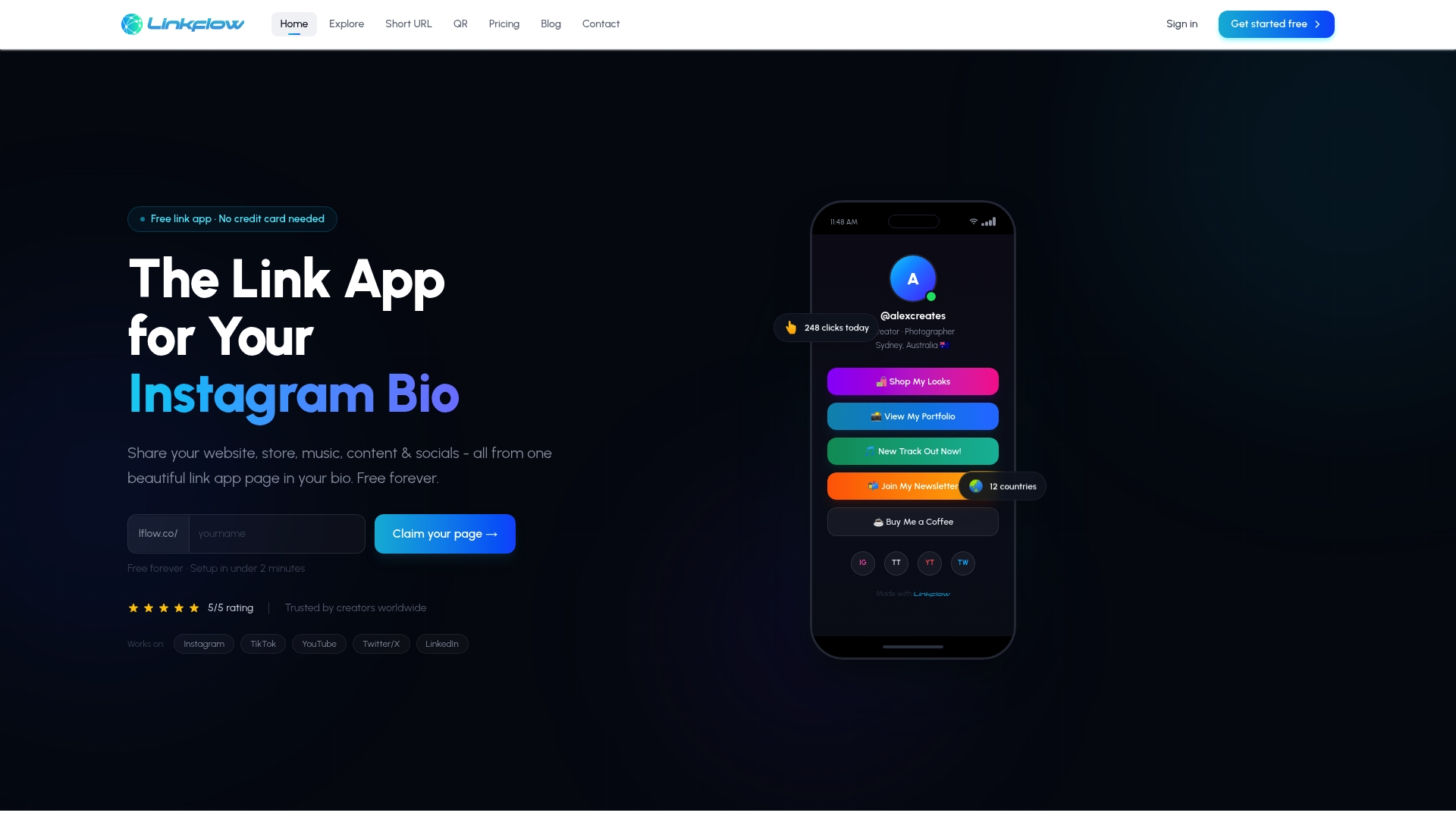
Setup takes under two minutes. Lflow's free link in bio templates let you build a professional, mobile-optimized hub that reflects your brand's colors, fonts, and style without any design experience. Real-time analytics show you exactly which links your audience clicks, so you can make smarter decisions about where to direct traffic. For brands serious about a unified social media presence, Lflow also offers a free link in bio tool with unlimited links and a free QR code for offline promotion.
FAQ
What is social media consolidation?
Social media consolidation is the practice of managing multiple social media accounts, content workflows, and analytics from one central system. The goal is to improve efficiency, brand consistency, and audience engagement across all platforms.
Why is social media consolidation important for businesses?
Consolidation reduces weekly posting time from 18 hours to roughly 90 minutes and prevents the inconsistent messaging that damages brand credibility. It also enables faster audience response times, with 35% of consumers expecting a reply within one hour.
What are the biggest risks of not consolidating social media?
Fragmented workflows cause inconsistent messaging, siloed analytics, and slow response times. Brands also face higher risk from algorithm changes when they rely on a single platform without a diversified, consolidated presence.
How does a link in bio page support social media consolidation?
A link in bio page creates one branded URL that connects all your platforms, content, and destinations in one place. It gives every social profile a single, consistent entry point that is easy to update and track.
How often should you audit a consolidated social media system?
A monthly audit is the standard practice. Review platform performance, update your content calendar, and adjust platform priorities based on engagement data and algorithm changes.