

Optimizing multiple links strategy is the process of consolidating and managing several URLs to maximize engagement and guide users efficiently across platforms. Content creators and marketers who scatter links across Instagram, TikTok, YouTube, and LinkedIn without a clear structure lose clicks, dilute authority, and confuse their audience. The solution is not more links. It is smarter link architecture built around consolidation, prioritization, and performance tracking. This article covers the tools, execution steps, and common mistakes you need to know to build a link strategy that actually works in 2026.
What tools do you need for multi-link optimization?
Effective multi-link optimization starts with the right tools and a clear audit of what you already have. Before adding or restructuring any links, you need to know which URLs are performing, which are broken, and which are sending your audience nowhere useful.
Start with a link audit. Pull every URL you currently share across your social profiles, email newsletters, and content. Check for broken links, outdated destinations, and pages with no clear conversion goal. Fixing broken internal links and cleaning up anchor text diversity improves crawl efficiency and the overall value your links pass to key pages.

Set measurable link goals. Every link you keep should serve a specific purpose: drive a sale, grow an email list, increase video views, or send traffic to a pillar piece of content. Links without a goal are noise. Align each URL to an audience engagement metric before you build your consolidated hub.
Here is a quick comparison of the core tool types you will need:
| Tool type | Primary function | Best for |
|---|---|---|
| Link in bio page | Consolidates multiple URLs into one landing page | Instagram, TikTok, YouTube creators |
| URL shortener | Brands and tracks individual links | Email, social captions, offline print |
| QR code generator | Connects offline audiences to online destinations | Events, packaging, physical media |
| Link audit tool | Identifies broken, redirected, or low-value links | Site-wide SEO health checks |
| Analytics dashboard | Tracks clicks, sources, and conversion rates | Performance review and iteration |
Key prerequisites before you build your multi-link hub:
- Audit all existing links and remove or redirect any that are broken or irrelevant
- Define one primary goal per link destination
- Choose a centralized platform that supports custom domains and real-time analytics
- Set a baseline click-through rate for each link so you can measure improvement
How do you execute a step-by-step multi-link strategy?
The industry term for what most creators call "link management" is link architecture. It describes how your URLs connect, flow authority, and guide users through your content ecosystem. Here is a practical roadmap.
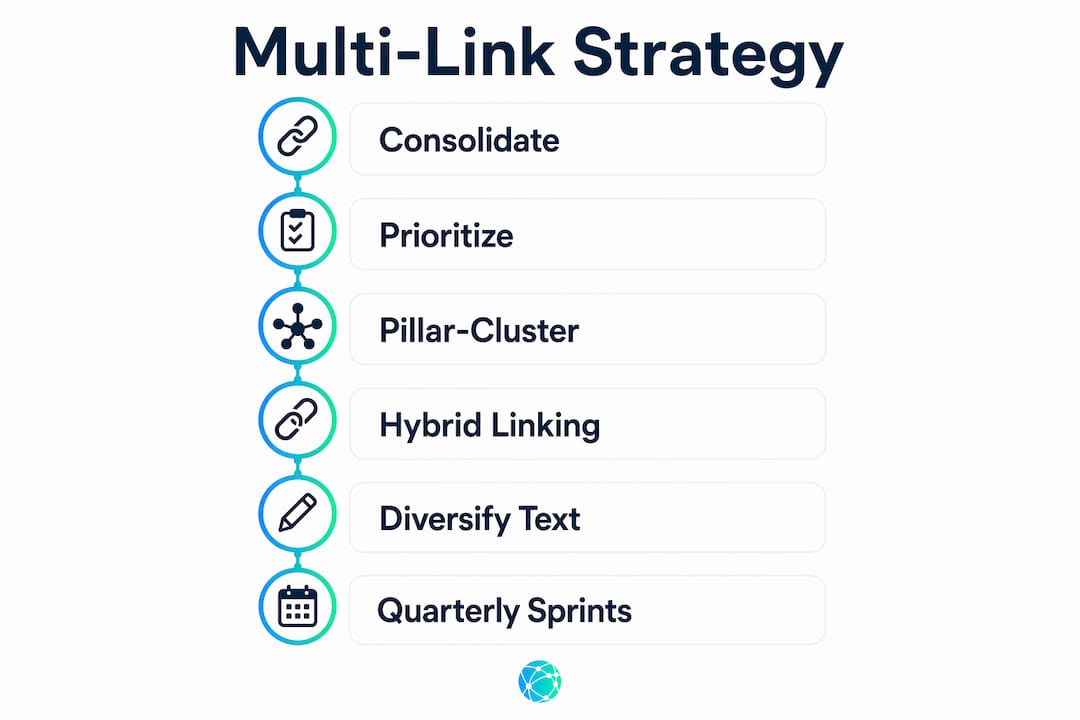
Step 1: Consolidate into a central hub. Send all your social traffic to one branded landing page that houses your most important links. This single URL replaces the scattered approach of dropping different links in different bios. Platforms like Lflow let you build this hub in under two minutes with custom themes, fonts, and a domain that matches your brand.
Step 2: Prioritize by authority and intent. Not all your pages deserve equal promotion. Pages ranking in positions 5–15 in search results offer the best return on link investment because they are close to page one but need a push. Prioritize those URLs in your hub and in your internal linking. Trying to force authority onto brand-new or low-performing pages usually fails. Focus on mid-tier pages that already have traction.
Step 3: Apply pillar-cluster link architecture. The pillar-cluster model concentrates topical authority on your most important pages and signals coherent content bodies to search engines. Your pillar page covers a broad topic. Cluster pages cover subtopics and link back to the pillar. Every cluster page also receives links from the pillar. This bidirectional flow keeps authority circulating rather than leaking out.
Step 4: Use hybrid linking patterns for large content sets. If you manage a large site or multiple content properties, a hub-and-spoke structure alone is not enough. Hybrid mesh linking patterns combine hub-and-spoke with cross-links between cluster pages. This delivers efficient crawl coverage and distributes authority across your full content library without creating dead ends.
Step 5: Diversify anchor text. Using the same anchor text repeatedly on every internal link is a signal that search engines penalize. Rotate between exact match, partial match, branded, and descriptive anchors. Keep your anchor text natural and relevant to the destination page.
Step 6: Run quarterly internal linking sprints. Internal linking sprints reviewed and executed quarterly can boost traffic by 10–20% to targeted pages within weeks. Pick 5–10 pages you want to grow, find existing content that can link to them, and add contextual links. This is one of the fastest traffic wins available without creating new content.
Pro Tip: Map your top 10 most-linked pages against your top 10 revenue-driving pages. If they do not overlap, you have a structural problem worth fixing before anything else.
Here is a quick reference for link architecture decisions:
| Content size | Recommended structure | Key benefit |
|---|---|---|
| Under 50 pages | Simple hub-and-spoke | Easy to manage, clear authority flow |
| 50–500 pages | Pillar-cluster model | Topical authority concentration |
| 500+ pages | Hybrid mesh plus pillar-cluster | Crawl efficiency at scale |
What are the most common multi-link mistakes to avoid?
Most creators and marketers do not fail at link strategy because they lack effort. They fail because they over-link, under-measure, and ignore the structural problems that compound over time.
Over-linking kills equity. Each additional link on a page dilutes the authority passed through every other link. Keep total page links under 100–150. This protects your crawl budget and keeps the equity flowing to pages that matter. A footer with 80 links and a navigation with 40 links already puts you at the edge before your body content adds a single URL.
Deep links outperform homepage links. Sending all your social traffic to your homepage is a missed opportunity. Deep links that point to specific product pages, lead magnets, or high-value content convert better and distribute authority more precisely. Reserve homepage links for brand awareness campaigns, not conversion goals.
Broken links waste crawl budget. Search engine crawlers follow every link they find. A broken link is a dead end that wastes crawl budget and signals poor site maintenance. Audit broken links at least once per quarter and redirect or remove them immediately.
Navigation and footer links need discipline. Links in global navigation and footers appear on every page of your site. That means they receive enormous link equity but also pass it to wherever they point. Be selective. Only link to your most strategically important pages from these locations.
Measure after every change. Link optimization without measurement is guesswork. Track click-through rates, time on page, and conversion rates for every destination in your hub. Use this data to rotate out underperforming links and promote high-converting ones.
The most common mistake I see is creators building a link hub and never looking at it again. Link performance analysis is not a one-time task. It is a recurring discipline that separates growing audiences from stagnant ones.
For a deeper look at common SEO link errors that affect small businesses and creators alike, the patterns are consistent: neglected audits, over-linked pages, and no clear measurement framework.
How does strategic link building fit your overall approach?
Strategic link building is the external counterpart to internal link architecture. Both work together to grow your authority and audience reach. Combining link strategies across internal and external channels produces compounding results that neither approach achieves alone.
Digital PR is the top link-building strategy in 2026, favored by 48.6% of SEO experts for acquiring high-quality backlinks. That means pitching original research, data studies, and expert commentary to publications that cover your niche. When those publications link back to your pillar pages, the authority flows down through your cluster content and strengthens your entire topic footprint.
Brand mention reclamation is an underused tactic. Search for your brand name across the web and find sites that mention you without linking. Reach out and ask for the link. Branded mentions correlate with AI visibility at 0.664, more than three times stronger than traditional backlinks at 0.218. That gap is significant. It means your brand name appearing in content, even without a hyperlink, carries real weight in how AI-driven search surfaces your work.
Link intent is the principle behind this. Creating uniquely valuable content attracts natural links without heavy outreach. Original data, proprietary frameworks, and well-researched guides earn links because other creators and journalists need to cite them. This is the most durable form of link acquisition available.
Sequential focus on one digital property at a time produces better results than spreading link-building resources across multiple sites simultaneously. If you run a blog, a YouTube channel, and a podcast, pick the property closest to ranking breakthroughs and concentrate your link-building there first. Once it gains momentum, shift focus to the next property.
Pro Tip: Build your link-building calendar around your pillar pages. Every piece of digital PR, every guest post, and every brand mention reclamation effort should point back to a pillar URL, not a random blog post.
For creators looking to connect AI-powered content creation with their link strategy, the combination of smart content and a well-structured hub accelerates both visibility and audience growth.
Key takeaways
A well-executed multi-link optimization strategy requires consolidation, prioritization, and consistent performance review to deliver lasting audience growth.
| Point | Details |
|---|---|
| Consolidate into one hub | Replace scattered bio links with a single branded landing page that houses your top URLs. |
| Prioritize mid-ranking pages | Focus link equity on pages in positions 5–15 for the fastest ranking improvements. |
| Use pillar-cluster architecture | Structure internal links so authority flows from broad pillar pages down to cluster content. |
| Keep page links under 150 | Exceeding 100–150 links per page dilutes equity and wastes crawl budget. |
| Measure and rotate quarterly | Run internal linking sprints every quarter and swap out underperforming links based on data. |
Why quality always beats quantity in link strategy
I have reviewed link setups for creators with 500,000 followers who were getting less social traffic than accounts a tenth their size. The pattern is almost always the same. Too many links, no clear hierarchy, and zero measurement. The instinct to add more links because you have more to share is understandable. It is also the fastest way to dilute everything you have built.
The SEO landscape in 2026 rewards brand signals and link quality far more than raw link volume. A single high-authority backlink from a relevant publication outperforms 50 low-quality directory links. The same logic applies to your bio page. Five well-chosen, clearly labeled links that match your audience's intent will always outperform a wall of 20 options that paralyze the user.
The mistake I see most often from experienced creators is neglecting centralized link management until something breaks. By then, they have months of diluted equity and confused analytics to untangle. Start with structure. Build the hub first. Add links only when they serve a defined goal. Review performance every quarter without exception. Results from link optimization are not instant, but they are reliable when the structure is sound. Patience and iteration beat volume every time.
— Axion
Put your link strategy to work with Lflow
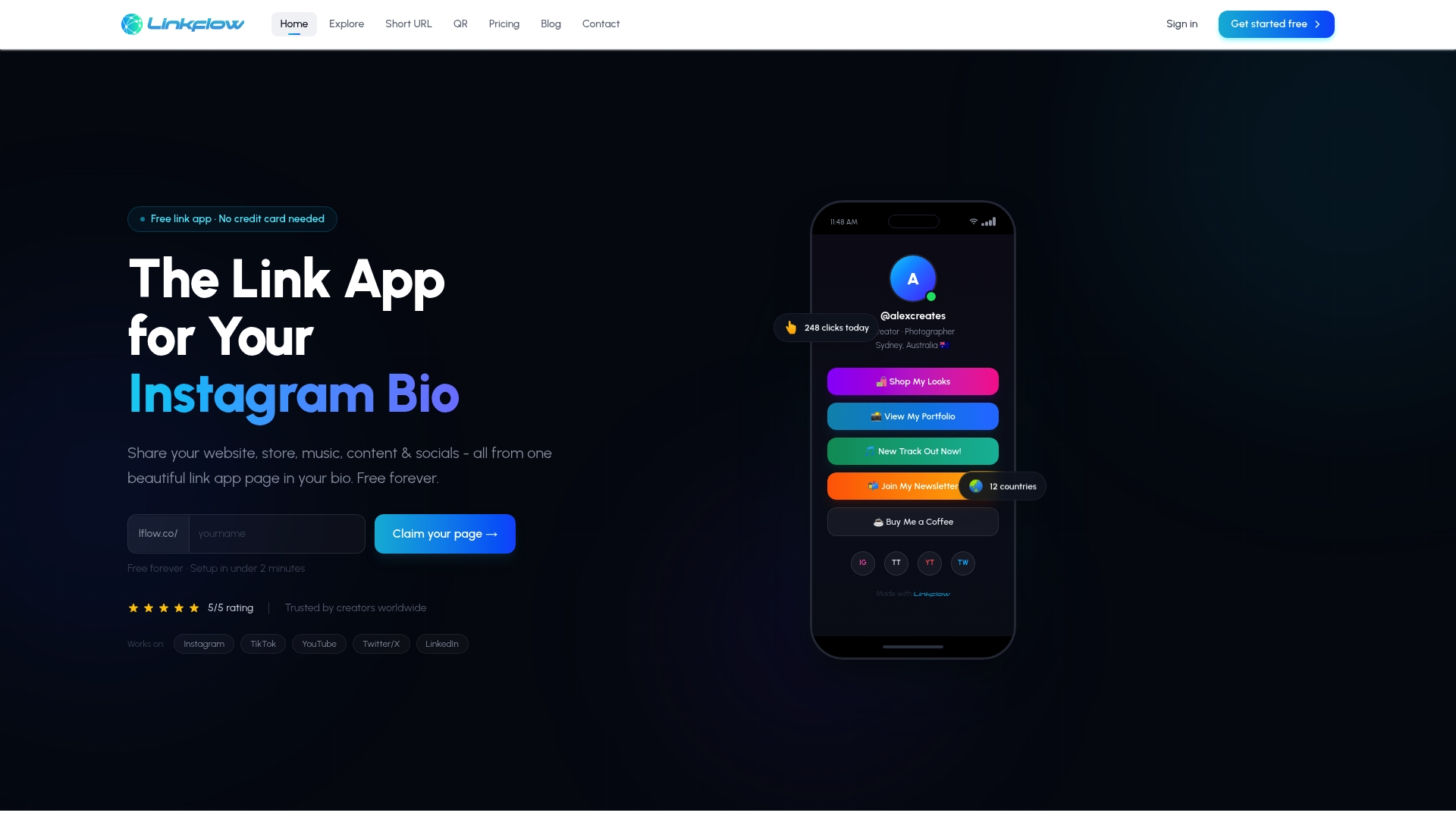
Lflow gives content creators and marketers the tools to put everything covered in this article into practice without technical complexity. The free link in bio page consolidates all your most important URLs into one branded, mobile-optimized hub that you can set up in under two minutes. Add a free QR code to connect offline audiences to your digital hub, and use Lflow's URL shortener to brand and track every individual link you share. Real-time analytics show you exactly which links your audience clicks, so you can rotate, prioritize, and grow with data behind every decision. Start free at lflow.co.
FAQ
What is a multi-link optimization strategy?
A multi-link optimization strategy is the practice of consolidating, prioritizing, and structuring multiple URLs to maximize user engagement and authority flow. It combines internal link architecture, centralized landing pages, and performance tracking into one coordinated approach.
How many links should I include on one page?
Keep total page links under 100–150 to protect crawl budget and prevent link equity dilution. Each additional link reduces the authority passed through every other link on that page.
What is the fastest way to improve traffic with link optimization?
Quarterly internal linking sprints that add contextual links to mid-ranking pages can boost traffic by 10–20% within weeks. Target pages already ranking in positions 5–15 for the best return.
Why are branded mentions important for link strategy?
Branded mentions correlate with AI search visibility at 0.664, more than three times stronger than traditional backlinks at 0.218. Reclaiming unlinked brand mentions and building brand recognition are now core components of any effective link strategy.
Do I need a separate tool for link in bio and URL shortening?
No. Platforms like Lflow combine a link in bio page, a URL shortener, and a QR code generator in one free tool, so you can manage your full multi-link setup from a single dashboard.