

To stay discoverable in 2026, creators must combine classic SEO with Generative Engine Optimization (GEO) and a structured, machine-readable link-in-bio hub. That single sentence is the whole game. Roughly 68% of Google searches now end without a click, and AI Overviews are appearing on a growing share of queries. If your link hub is not machine-readable, AI systems simply skip you.
Three things you can do right now, in under 10 minutes:
- Update your bio copy to lead with a fact-dense, one-sentence description of what you do and who you serve.
- Add structured fields (name, URL, social handles) to your link hub so AI agents can parse your identity.
- Generate a QR code for your hub and drop it into your next post or story for offline-to-online tracking.
Pro Tip: Treat your link hub as an entity, not a landing page. Concise, fact-dense statements give AI systems something quotable. Vague brand narratives give them nothing.
Table of Contents
- What are the core SEO trends that matter for creators in 2026?
- How do you set up your link hub to capture 2026 SEO signals?
- What technical checks does your link hub actually need?
- How should creators measure visibility in 2026?
- What does a 30/60/90 day roadmap look like for creators?
- What mistakes are creators making right now?
- Key Takeaways
- Why machine-readability beats clever content tricks
- Lflow makes the 30-day checklist faster to execute
- Further reading and authoritative sources
What are the core SEO trends that matter for creators in 2026?
The biggest shift is that search now has three layers: classic SEO (ranking blue links), AEO (winning featured snippets), and GEO, which focuses on being cited inside AI-generated answers. Marco Diversi describes GEO as complementary to classic SEO, not a replacement. Creators who only chase rankings are leaving the highest-converting traffic on the table.
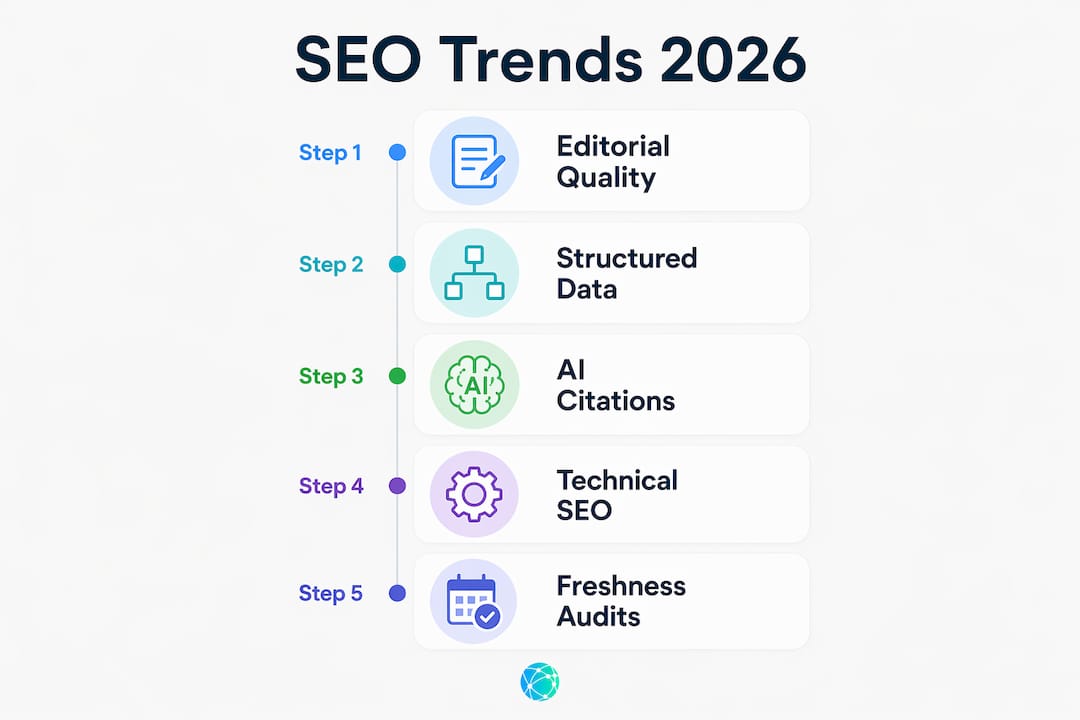
Yoast's 2026 SEO experts put it plainly: editorial quality and structured data are no longer optional extras. They are baseline eligibility signals for AI-driven visibility. A link hub without schema.org markup is like a store with no sign.
Platform search is real. TikTok, Instagram, and YouTube increasingly act as secondary indexes for discovery. Captions, transcripts, and alt text on your videos are not accessibility afterthoughts. They are the raw text AI summarizers and platform search engines actually read.
A few other trends worth tracking:
- Topical authority over keyword chasing. Hub-and-spoke content ecosystems outperform single-keyword pages because they signal expertise across a topic, not just one query.
- Mobile-first performance. A majority of global web traffic now comes from mobile devices, Google indexes your mobile experience first. A slow link hub hurts rankings and AI consumption alike.
- Privacy-aware measurement. Third-party cookies are fading. US creators need first-party event tracking, UTM parameters, and QR scan data to understand what is actually working.
How do you set up your link hub to capture 2026 SEO signals?
Start with the copy. Your bio description should answer three questions in two sentences: who you are, what you make, and who it is for. Verbose brand narratives give AI nothing to cite. Fact-dense, answer-first lines give AI exactly what it needs.
Structural checklist for your link hub
- One canonical URL (no redirect chains, no platform-generated slugs)
- Consistent name across Instagram, TikTok, and YouTube — exact same spelling
- Explicit services or content categories listed as text, not just icons
- Contact metadata (email or booking link) visible as a text field
- Links ordered by priority: primary call to action first, freshest content second, evergreen assets third
JSON-LD schema for a creator entity
Paste this into your hub's <head> and fill in your details:
{
  "@context": "https://schema.org",
  "@type": "Person",
  "name": "Your Name",
  "url": "https://yourhub.com",
  "sameAs": [
    "https://instagram.com/yourhandle",
    "https://tiktok.com/@yourhandle",
    "https://youtube.com/@yourchannel"
  ],
  "brand": {
    "@type": "Brand",
    "name": "Your Brand Name"
  },
  "contactPoint": {
    "@type": "ContactPoint",
    "contactType": "business inquiries",
    "email": "you@yourdomain.com"
  }
}
The sameAs array is the most important field here. It tells AI systems that your Instagram, TikTok, and YouTube profiles all belong to the same entity. Without it, each platform looks like a separate, unrelated account.
Open Graph tags handle shareability. Add these to your hub's <head>:
<meta property="og:title" content="Your Name | Creator Hub" />
<meta property="og:description" content="One-sentence fact-dense bio." />
<meta property="og:image" content="https://yourhub.com/og-image.jpg" />
<meta property="og:url" content="https://yourhub.com" />
Gist.ai recommends fact-dense statements, clear schema markup, and scannable lists to increase AI citation probability. That maps directly to how you should write every line on your hub.
Pro Tip: Map three to five questions your audience asks most often and surface direct, one-sentence answers on your hub. AI systems quote pages that answer questions cleanly. "What does [your name] do?" should have a one-sentence answer visible in your page text.
What technical checks does your link hub actually need?
| Check | Why It Matters | Test Tool |
|---|---|---|
| Core Web Vitals (LCP under 3 seconds, INP low, CLS minimal) | Only about half of websites pass all Core Web Vitals checks; passing sites tend to see organic traffic gains | Google PageSpeed Insights |
| Canonical tag | Prevents duplicate-content confusion for crawlers and AI agents | Google Search Console |
| Robots.txt allows crawling | A blocked hub is invisible to every search surface | robots.txt tester in Search Console |
| XML sitemap includes hub URL | Speeds up indexation and freshness signals | Screaming Frog or Sitebulb |
| HTTPS | Many users leave sites flagged as insecure | Browser address bar |
| Images in AVIF or WebP format | Cuts load time without quality loss | Squoosh or Cloudinary |
For your canonical and robots basics:
<link rel="canonical" href="https://yourhub.com" />
<meta name="robots" content="index, follow" />
Lazy-load any embedded videos or social widgets. They are the single biggest drag on mobile load time for link hub pages, and even small delays in load time can significantly increase bounce rate.
Pro Tip: Run PageSpeed Insights on your hub once a month. A score drop often signals a new embed or image that crept in without optimization.
How should creators measure visibility in 2026?
The metrics that mattered in 2023 (raw pageviews, follower count) are not the metrics that predict growth now. Track these instead:
- Branded search volume: Are people searching your name directly? Rising branded search is the clearest signal that AI and social discovery are working.
- AI citation mentions: Use tools like Perplexity or ChatGPT to search your niche and check whether your hub or content appears in answers.
- QR scan volume: Offline-to-online conversion is measurable and privacy-safe.
- CTR from bio links: Your link hub's real-time analytics show which destinations actually convert.
- Conversion rate by source: UTM-tagged links reveal whether AI referral traffic, direct bio clicks, or QR scans produce the best outcomes.
Early industry data shows AI referrals converting at significantly higher rates than average organic traffic. That is the argument for prioritizing citation readiness over raw click volume.
For US creators, avoid building your measurement stack on third-party cookies. Use first-party event tracking (Google Analytics 4's server-side events or a privacy-first alternative), explicit consent flows, and UTM parameters on every link. QR codes with embedded UTMs give you clean attribution for offline campaigns without any cookie dependency.
Pro Tip: Set up a simple monthly dashboard: branded search impressions (Search Console), QR scans (your link hub analytics), and top-converting bio link destinations. Fifteen minutes a month is enough to spot what is working.
What does a 30/60/90 day roadmap look like for creators?
Days 1–30: Build the foundation
- Create or migrate to a structured link hub with a custom domain.
- Add JSON-LD schema and Open Graph tags.
- Set canonical URL and verify crawlability in Search Console.
- Rewrite bio copy to be fact-dense and answer-first.
- Generate QR codes for your top two campaigns and deploy them.
Days 31–60: Build topical signals
- Publish transcripts for your top five YouTube or TikTok videos.
- Add descriptive alt text to all images on your hub and recent Instagram posts.
- Launch your first QR campaign and record baseline scan metrics.
- Start a simple content hub: link your hub to two or three long-form pieces that validate your expertise.
Days 61–90: Build authority and iterate
- Reach out to two or three relevant publications or podcasts for mentions or features.
- Review link hub analytics and reorder links based on actual click data.
- Run a freshness audit on your hub: remove dead links, update stale copy, and refresh your top call to action.
- Test one new format (a short FAQ section, a featured answer block) for AI citation readiness.
Off-page brand signals — unlinked mentions, social posts, forum citations — feed AI models' entity trust. The 90-day outreach push is not optional if you want AI systems to treat you as a credible entity.
What mistakes are creators making right now?
Verbose, brand-first hub copy. Long "about me" narratives give AI nothing to cite. Replace them with fact-dense, answer-first lines and back them with schema.
Ignoring multimodal signals. No transcripts on YouTube videos, no captions on TikTok, no alt text on Instagram images. These are the text layers AI summarizers actually read. Fix them retroactively on your top 10 posts first.
Stale link lists. A dead link on your hub signals neglect to both visitors and crawlers. Regular audits and pruning maintain freshness signals that matter for AI eligibility.
Chasing raw traffic over brand signals. A thousand low-quality clicks from a viral post matter less than 50 branded searches and two AI citations. Prioritize citation readiness and third-party mentions.
Pro Tip: Block 15 minutes on the first Monday of each month for a hub audit: check for dead links, update your top call to action, and review your QR scan and CTR data.
Key Takeaways
Creators who combine classic SEO with GEO, structured link-hub markup, and monthly freshness audits will capture the highest-converting traffic surfaces in 2026.
| Point | Details |
|---|---|
| GEO + SEO dual approach | Optimize for both Google rankings and AI citations; AI referrals convert at higher rates than average organic traffic. |
| Machine-readable hub | Add JSON-LD schema and Open Graph tags so AI systems can parse your identity and cite your content. |
| Multimodal signals | Publish transcripts, captions, and alt text on YouTube, TikTok, and Instagram posts to feed AI summarizers. |
| Monthly freshness audits | Pruning stale links and refreshing copy preserves AI citation eligibility and outperforms constant new publishing. |
| Lflow for execution | Lflow's free link hub, QR code generator, and real-time analytics map directly to the 30/60/90 roadmap above. |
Why machine-readability beats clever content tricks
The conventional wisdom in creator SEO is to publish more, post more, and chase trending keywords. That approach made sense when search was a single channel. Now that ChatGPT, Perplexity, and Google's AI Overviews are pulling answers from structured, citable sources, volume without structure is noise.
What actually moves the needle is treating your link hub as a brand entity: consistent naming, explicit schema, fact-dense copy, and a clean canonical URL. Creators who do this become the default reference in their niche. Creators who do not become invisible to the surfaces where the highest-converting traffic now lives.
The 30/60/90 roadmap is not a theory. It is the minimum viable execution path. Spend the first month on structure, the second on topical signals, and the third on authority. That sequence compounds. Clever content tricks do not.
Lflow makes the 30-day checklist faster to execute
Your link hub is the single most important SEO asset you control directly. Lflow gives you a free, structured link-in-bio page with unlimited links, a built-in QR code generator, custom domains, and real-time click analytics — everything the 30-day sprint above requires, set up in under two minutes.
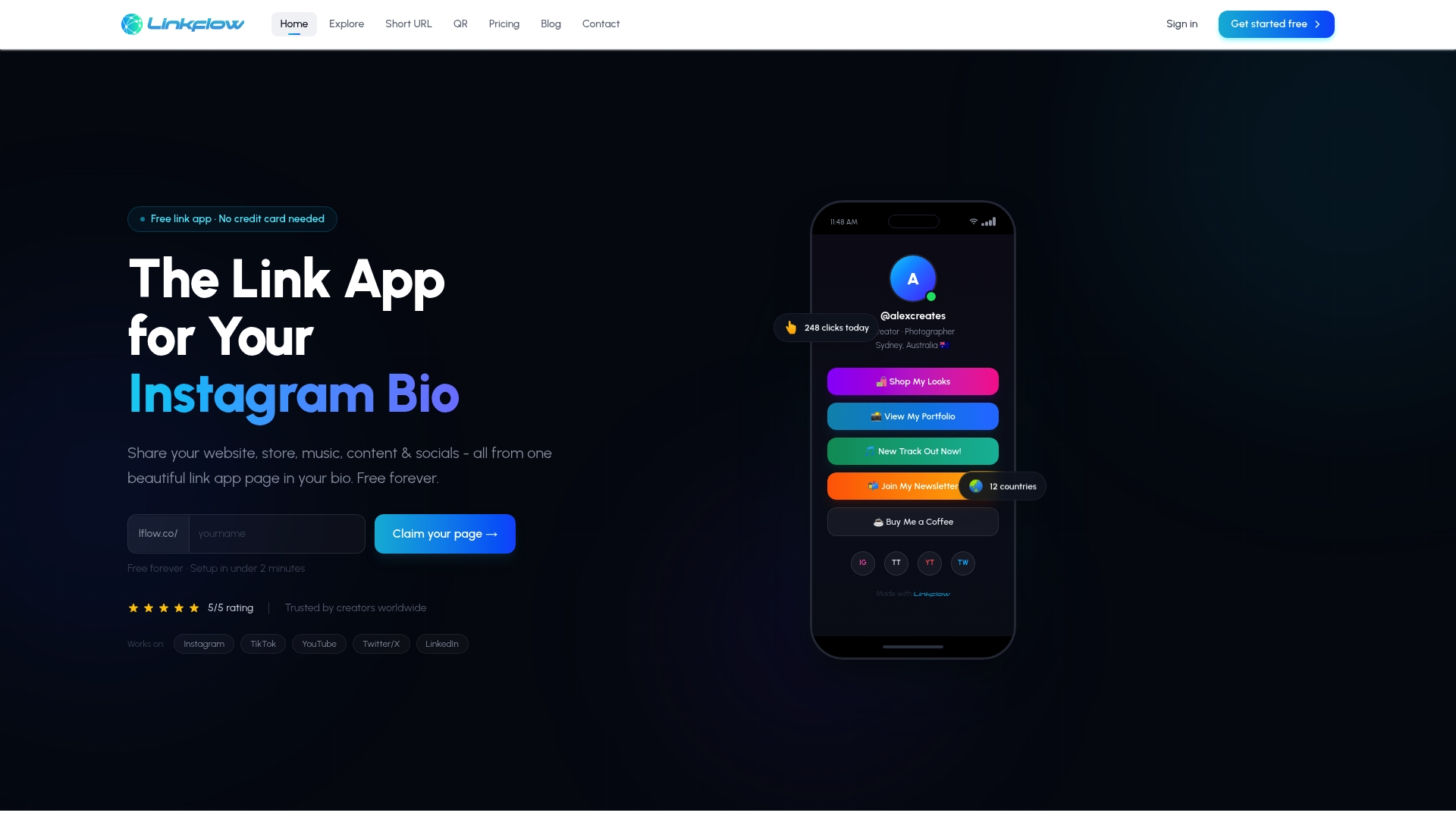
The free plan covers the full foundation: structured hub, QR codes, short URLs, and analytics. Paid plans add custom domains, branding removal, advanced analytics, and CSV export for deeper measurement work. For creators who want to optimize their link in bio without stitching together five separate tools, Lflow is the direct path. Start your free hub at lflow.co and have your JSON-LD-ready, analytics-tracked link page live before your next post goes out.
Further reading and authoritative sources
The sources below shaped this guide. Each is worth bookmarking for ongoing trend updates.
- Marco Diversi: The Future of SEO in the AI Era — The clearest breakdown of GEO as a discipline and why AI citations matter more than raw rankings for conversion quality.
- Yoast: 2026 SEO Predictions — Structured data as a baseline requirement, straight from the team behind the most-used SEO plugin.
- Skyhoora: SEO, AEO & GEO Guide 2026 — The best single-source explanation of how SEO, AEO, and GEO work as complementary layers.
- Gist.ai: The Future of SEO — Practical guidance on fact-dense content and schema markup for AI citation readiness.
- Search Engine Land: Future of SEO — Off-page brand signals and how unlinked mentions feed AI entity trust.
- Ahrefs: SEO Trends — Third-party brand mentions and entity signals as measurable visibility factors.
- ClickMinded: SEO Strategy — The case for updating existing content over constant new publishing, with practical audit frameworks.
- HubSpot: The Future of SEO — Social platforms as secondary discovery indexes and how they feed AI brand recognition signals.
- Backlinko: SEO Strategy — Hub-and-spoke content architecture and why topical authority outperforms single-keyword targeting.
"The future of SEO is a split discipline. Do classic SEO and GEO together — double leverage, but follow fundamentals first." — Marco Diversi
This article is general information for educational purposes. Confirm current platform policies, technical standards, and privacy regulations with the relevant primary sources or a qualified professional for your specific situation.