

Your link in bio is not a placeholder. For creators, influencers, and small business owners, it's often the single most visited URL across every platform you're active on. Yet most people treat it like a sticky note, a quick list of links slapped together and forgotten. The reality is that flexible bio pages have evolved into powerful, customizable landing pages that can capture leads, sell products, and build your brand around the clock. This guide breaks down exactly what they are, what you can build with them, and how to use them strategically to grow your audience and your revenue.
Table of Contents
- What is a flexible bio page?
- Core components and customization options
- Why flexible bio pages matter for creators and businesses
- Best practices and tips for maximum results
- Why most creators underestimate flexible bio pages
- Start building your flexible bio page with Linkflow
- Frequently asked questions
Key Takeaways
| Point | Details |
|---|---|
| Full flexibility | Flexible bio pages let you build a unique, branded landing page for all your links and content. |
| Customization options | Easily tailor fonts, colors, and layouts—and even use your own domain—to match your brand. |
| Business-ready tools | Integrated storefronts, forms, and analytics make bio pages powerful business platforms. |
| Higher engagement | Prioritizing top actions and using strategic layouts keeps your audience focused and clicking. |
What is a flexible bio page?
A flexible bio page is a mobile-optimized landing page you control entirely, built to live behind a single shareable URL. Unlike a basic link aggregator that just stacks clickable text, a flexible bio page works more like a mini-website. It can hold embedded videos, email capture forms, product storefronts, social feeds, and branded design elements, all in one place.
The word "flexible" is doing a lot of work here. It refers to the ability to rearrange, add, or remove content blocks without touching a single line of code. Most platforms use drag-and-drop editors, meaning you can restructure your entire page in minutes. Want to move your newsletter sign-up above your latest YouTube video? Done. Need to add a limited-time product block for a weekend sale? Easy.
Flexible bio pages allow users to create mobile-optimized landing pages with drag-and-drop builders, customizable blocks, and real-time analytics. That combination is what separates them from the old-school link lists that dominated the early days of Instagram.
Modern bio pages are not just traffic routers. They are your digital storefront, your email list builder, and your brand statement, all wrapped into one URL.
For deeper bio page tips on getting the most from your setup, it helps to first understand what building blocks you're actually working with. Here's a quick summary:
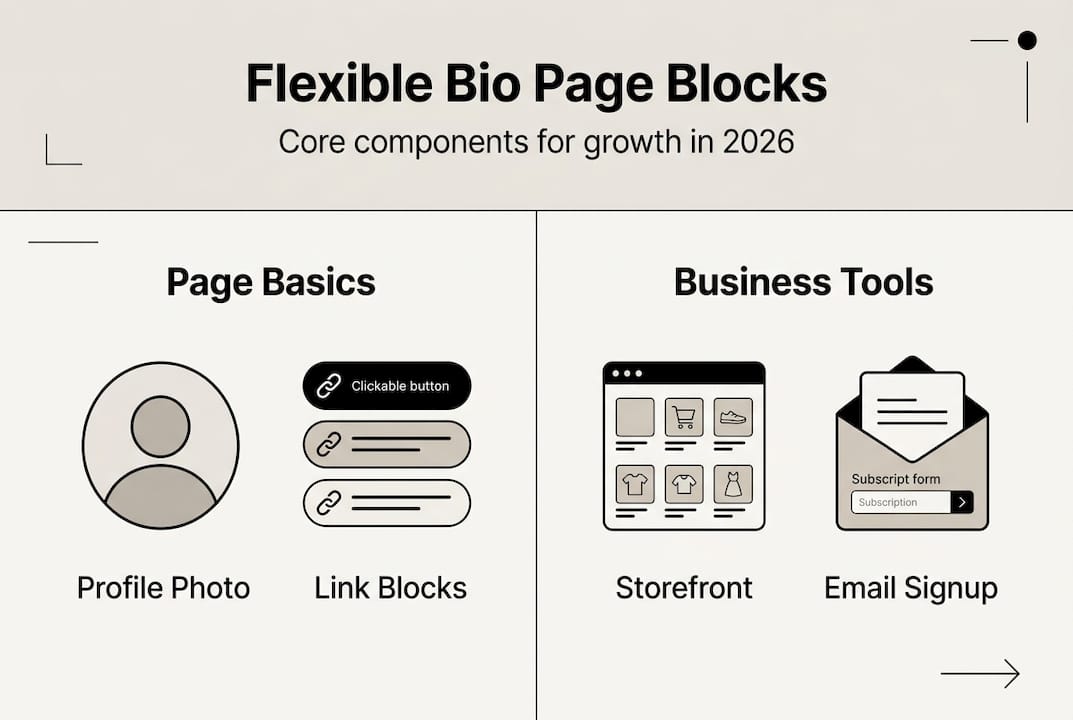
- Link blocks: Direct visitors to any external URL, from blog posts to product pages
- Media embeds: Showcase videos, podcasts, or social content directly on the page
- Forms: Collect emails, survey responses, or booking requests
- Storefronts: Sell digital products, courses, or services without leaving the page
- Custom design: Apply your brand colors, fonts, and layout preferences
- Analytics: Track clicks, visits, and engagement in real time
- Custom domain: Replace generic platform URLs with your own branded address
Each of these blocks turns your bio page from a passive list into an active business tool.
Core components and customization options
With a clear definition in mind, it's time to see what you can actually build and customize on these pages.
The structure of a flexible bio page is modular. Think of it like building with blocks. You choose what goes in, where it sits, and how it looks. That modularity is what makes these pages so powerful for creators who need to serve different audiences or promote different things at different times.

Customizing fonts, colors, themes, and even custom domains gives you both branding consistency and stronger data control. That matters because every time someone lands on your page, they're forming an impression of your brand in under three seconds.
Here's a breakdown of what most flexible bio page platforms offer:
| Feature | What it does | Why it matters |
|---|---|---|
| Link blocks | Direct traffic to any URL | Core navigation for your audience |
| Media embeds | Show videos, audio, or social posts | Keeps visitors engaged longer |
| Email capture forms | Grow your list directly from bio | Builds owned audience |
| Storefronts | Sell products or services | Monetizes your traffic directly |
| Custom design | Fonts, colors, themes | Reinforces brand identity |
| Analytics dashboard | Tracks clicks and visits | Informs smarter decisions |
| Custom domain | Your own branded URL | Boosts trust and professionalism |
Beyond the table, the real power comes from how these features interact. Pairing a storefront block with an analytics dashboard, for example, lets you see exactly which products get the most clicks, so you can prioritize what to promote next.
Pro Tip: Set up a custom domain for your bio page as early as possible. A URL like yourname.com instantly signals professionalism and makes your page far more memorable than a generic platform link.
Popular customization choices and their impact include:
- Brand color palette: Creates instant visual recognition across platforms
- Custom font pairing: Matches your content style and persona
- Themed layouts: Sets the tone before visitors read a single word
- Social feed integrations: Keeps your page dynamic without manual updates
- E-commerce connections: Turns passive visitors into paying customers
Exploring link in bio templates is a smart way to find a starting point that already fits your niche, then layer on your custom branding options from there.
Why flexible bio pages matter for creators and businesses
Once you understand what's possible, it's important to see why these features actually matter for your goals.
Every creator and small business owner faces the same core challenge: you have one link, but dozens of things you want to share. A flexible bio page solves that problem without overwhelming your audience. Instead of forcing followers to choose from a wall of options, you can guide them toward the actions that matter most to your business right now.
Flexible bio pages support multiple business actions, reduce decision fatigue, and increase conversion rates through prioritized calls to action. That's not a minor improvement. It's the difference between a page that converts and one that just exists.
Here's how flexible bio pages compare to traditional link in bio tools:
| Feature | Traditional link in bio | Flexible bio page |
|---|---|---|
| Layout control | Fixed, linear | Drag-and-drop, modular |
| Conversion tools | Links only | Forms, storefronts, CTAs |
| Analytics | Basic or none | Real-time, detailed |
| Branding | Minimal | Full custom design |
| Domain options | Platform URL | Custom domain supported |
Top reasons creators and small businesses use flexible bio pages:
- Drive targeted traffic to specific campaigns, products, or content without changing your main URL
- Capture leads through embedded email forms directly on the page
- Sell products or services without redirecting visitors to a separate site
- Build brand recognition through consistent visual identity across every touchpoint
- Track performance with real-time data to understand what your audience actually clicks
Real-world use cases make this even clearer. A musician can feature a new album, a ticket link, and a merch store all in one place. A fitness coach can run event registrations and sell digital programs simultaneously. A blogger can grow their email list while promoting their latest post. Explore AI-powered link in bio strategies to see how smart content planning amplifies these results even further.
Best practices and tips for maximum results
To truly make the most out of your flexible bio page, apply these best practices.
Building a high-performing bio page is not about adding everything you can. It's about making deliberate choices. Prioritizing primary actions, using A/B testing, optimizing for search, and owning your page with a custom domain all contribute to better data control and stronger results.
Here's a step-by-step process to build your page the right way:
- Choose a platform that supports drag-and-drop editing, analytics, and custom domains
- Start with a template that fits your niche, then customize fonts and colors to match your brand
- Prioritize your top CTA (call to action) and place it above the fold where it's immediately visible
- Add only the links that serve a current goal and remove anything that creates unnecessary choices
- Connect your analytics so you can track which blocks drive the most engagement
- Set up your custom domain to reinforce trust and maintain brand consistency
Pro Tip: Run A/B tests on your page layout every few weeks. Swap the order of your top two blocks and compare click-through rates over seven days. Small changes in placement can produce significant shifts in conversions.
Common mistakes to avoid:
- Overcrowding the page with too many links, which overwhelms visitors and reduces clicks on what matters
- Using weak CTAs like "click here" instead of specific, action-oriented phrases like "grab your free guide"
- Ignoring analytics and missing the data that tells you what's actually working
- Skipping branding customization and leaving a generic-looking page that erodes trust
- Forgetting mobile optimization even though the majority of bio page visits happen on phones
For inspiration on visual design, check out resources on better bio page design. And if you want to go deeper on content strategy, pairing your page with AI for link in bio tools can streamline the entire process. A solid domain tracking guide will also help you measure performance accurately once your custom domain is live.
Why most creators underestimate flexible bio pages
After learning how to put best practices to work, let's look at where most people go wrong and how you can go further.
Here's an uncomfortable truth: the majority of creators use their bio page as a parking lot. They set it up once, add a few links, and move on. The page sits there, static and forgettable, while they spend hours crafting content on platforms they don't own.
That's a missed opportunity at a fundamental level. Your bio page is one of the few digital assets you actually control. Social algorithms change. Platforms rise and fall. But your bio page, especially one on a custom domain, belongs to you.
The creators who see real results treat their bio page like a living business asset. They update it with every campaign. They test layouts. They use it to build their email list because they understand that AI content for bio pages and smart strategy together create compounding returns over time.
Flashy animations and trendy fonts don't drive growth. Clear CTAs, owned data, and consistent updates do. The gap between a bio page that earns and one that just exists is almost always strategic, not technical.
Start building your flexible bio page with Linkflow
Ready to get hands-on? Here's how Linkflow helps you build your perfect flexible bio page in minutes.
Linkflow gives you everything covered in this guide, without the complexity or the cost. You can launch a fully branded, mobile-optimized bio page in under two minutes using a free Link in Bio builder that requires zero design experience.
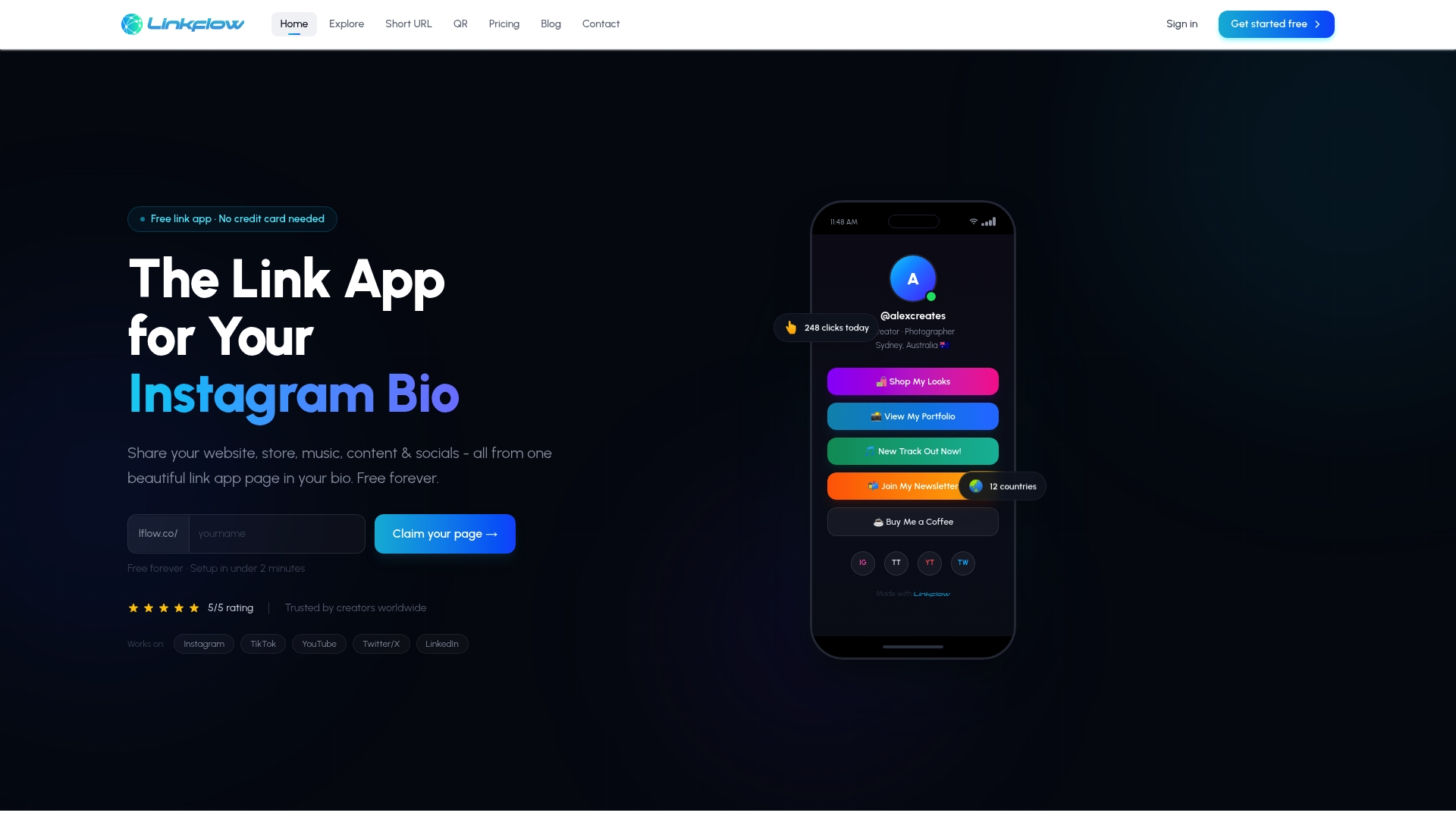
Start by browsing the library of free templates to find a layout that fits your style, then customize colors, fonts, and blocks to make it entirely yours. Add your links, connect your analytics, and set up your custom domain to take full ownership of your page. Start with Linkflow today and turn your single bio link into your most powerful marketing asset.
Frequently asked questions
What features set flexible bio pages apart from ordinary link in bio tools?
Flexible bio pages provide drag-and-drop customization, block-based layouts for links, media, forms, e-commerce, plus analytics and branding. Unlike basic tools, they support storefronts, embeds, and full design control in one mobile-optimized page.
How do flexible bio pages help increase engagement?
By prioritizing primary actions and offering seamless integrations, they reduce decision fatigue and drive more conversions. Prioritizing key CTAs keeps visitors focused and more likely to act.
Is it important to use a custom domain for a flexible bio page?
Yes, using your own domain boosts trust, branding, and gives you greater control over your data and appearance. Owning your domain also protects you if you ever switch platforms.
Can I sell products or collect emails on a flexible bio page?
Absolutely. Modern bio pages support storefronts and forms for email capture, digital product sales, bookings, and more, all without redirecting visitors to a separate site.
What are common mistakes to avoid when building a flexible bio page?
Avoid cluttered layouts, weak calls to action, and neglecting analytics or branding customization. Prioritizing key actions and tracking performance are the two habits that separate high-converting pages from forgettable ones.